
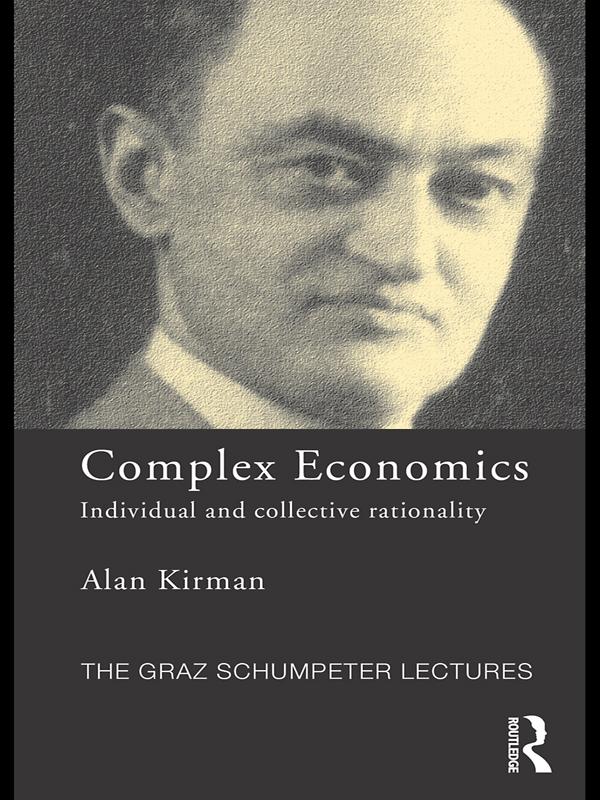
The economic crisis is also a crisis for economic theory. Most analyses of the evolution of the crisis invoke three themes, contagion, networks and trust, yet none of these play a major role in standard macroeconomic models. What is needed is a theory in which these aspects are central. The direct interaction between individuals, firms and banks does not simply produce imperfections in the functioning of the economy but is the very basis of the functioning of a modern economy. This book suggests a way of analysing the economy which takes this point of view.
The economy should be considered as a complex adaptive system in which the agents constantly react to, influence and are influenced by, the other individuals in the economy. In such systems which are familiar from statistical physics and biology for example, the behaviour of the aggregate cannot be deduced from the behaviour of the average, or "representative" individual. Just as the organised activity of an ants’ nest cannot be understood from the behaviour of a "representative ant" so macroeconomic phenomena should not be assimilated to those associated with the "representative agent". This book provides examples where this can clearly be seen. The examples range from Schelling’s model of segregation, to contributions to public goods, the evolution of buyer seller relations in fish markets, to financial models based on the foraging behaviour of ants.
The message of the book is that coordination rather than efficiency is the central problem in economics. How do the myriads of individual choices and decisions come to be coordinated? How does the economy or a market, "self organise" and how does this sometimes result in major upheavals, or to use the phrase from physics, "phase transitions"? The sort of system described in this book is not in equilibrium in the standard sense, it is constantly changing and moving from state to state and its very structure is always being modified. The economy is not a ship sailing on a well-defined trajectory which occasionally gets knocked off course. It is more like the slime described in the book "emergence", constantly reorganising itself so as to slide collectively in directions which are neither understood nor necessarily desired by its components.
Pay easily by card, Klarna, Apple Pay or Google Pay. Not happy? You always have a 14-day money-back guarantee. Read more in our terms. If you have any questions, email us at hello@memmo.org.
Memmo makes studying easier – wherever you are in the world. We bring your course books and smart study tools together in one place: summaries, quizzes, podcasts and flashcards. Plus Ted, your study buddy who answers anything you wonder. Over 50,000 students already study here – built to help you learn faster and stress less.