
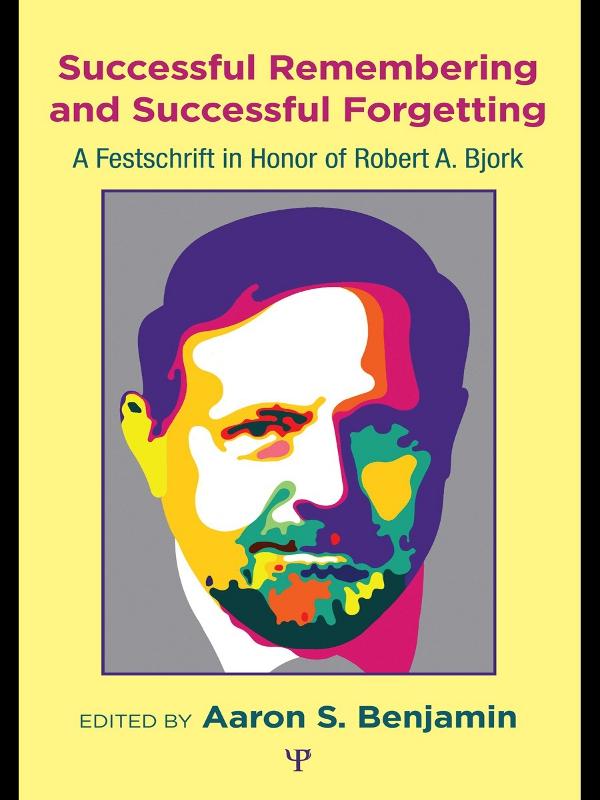
The chapters in this volume are testament to the many ways in which Robert Bjork’s ideas have shaped the course of research on human memory over four decades. It showcases the theoretical advances and recent findings by researchers whose work and careers have been influenced by Bjork.
The first group of chapters explore the idea that forgetting is an adaptive response to the demands of a retrieval system fraught with competition - an idea that has helped recalibrate conceptualizations of memory away from one in which in which the computer is the dominant metaphor.
Several chapters then review the application of research on learning and memory to enhancing human performance, reflecting Bjork’s staunch commitment to translating his findings and theories to real-world settings.
Later chapters address topics that are relevant to the translation of cognitive psychology to human performance, and in particular recognize the critical role of metacognition in such problems.
The final chapters cover a variety of issues related to how remembering can be enhanced, and how research on remembering can be profitably guided by the use of mathematical modeling.
This volume will appeal to researchers and graduate students of human learning, memory, and forgetting, and will also benefit an audience working in applied domains, such as training and education.
Pay easily by card, Klarna, Apple Pay or Google Pay. Not happy? You always have a 14-day money-back guarantee. Read more in our terms. If you have any questions, email us at hello@memmo.org.
Memmo makes studying easier – wherever you are in the world. We bring your course books and smart study tools together in one place: summaries, quizzes, podcasts and flashcards. Plus Ted, your study buddy who answers anything you wonder. Over 50,000 students already study here – built to help you learn faster and stress less.