
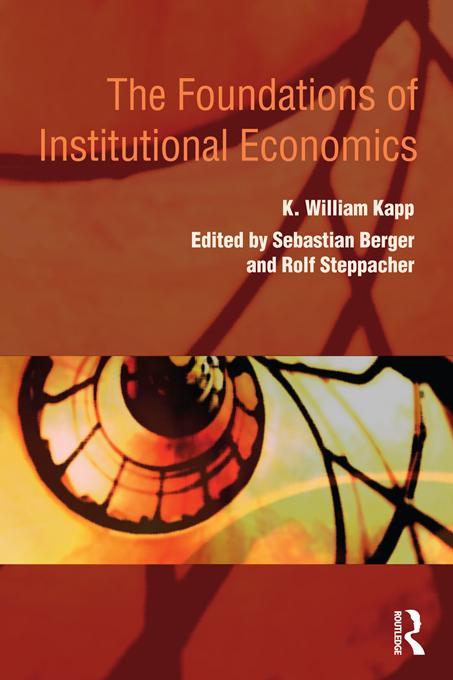
This is a ground-breaking book about the foundations of institutional economics. K. William Kapp presents the economic role of institutions for economic development, capital formation and technological dynamics in an easily accessible and comprehensive manner. As a front-rank 20th century institutional economist, Kapp pulls together arguments from a variety of sources, including Thorstein Veblen, John Kenneth Galbraith and Gunnar Myrdal, all of which emphasize the crucial role of institutions. The author cements institutional economics as a distinct and coherent framework of analysis to effectively address urgent socio-economic problems, such as environmental disruption and sustainable development.
This book begins with a critique of conventional (neoclassical) economics and an overview of the antecedents of institutional economics. The core of the book is formed by the chapters on institutions, human economic behavior and needs, arguing that institutional change is key to directing economic development towards sustainable and adequate living conditions, rather than merely formal growth formulas. The final chapters provide the reader with the institutional theories of capital and technology, showing how capital formation and technological dynamics are determined by institutions, such as the principle of investment for profit. The appendix complements Kapp’s plea for institutional change with articles on science and technology, social costs, substantive economics, and circular and cumulative causation.
This book is suited for readers at all levels who are interested in institutional economics, the history of economics thought, political economics as well as ecological and heterodox economics. Researchers and students will find it to be an easily accessible and a concise elaboration on the foundations of institutional economics.
Pay easily by card, Klarna, Apple Pay or Google Pay. Not happy? You always have a 14-day money-back guarantee. Read more in our terms. If you have any questions, email us at hello@memmo.org.
Memmo makes studying easier – wherever you are in the world. We bring your course books and smart study tools together in one place: summaries, quizzes, podcasts and flashcards. Plus Ted, your study buddy who answers anything you wonder. Over 50,000 students already study here – built to help you learn faster and stress less.