
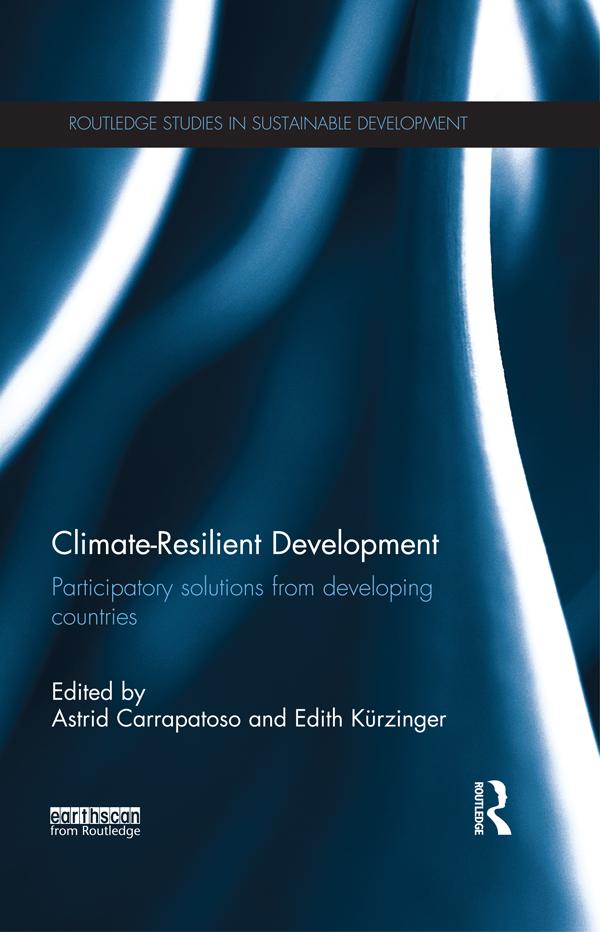
The concept of resilience currently infuses policy debates and public discourse, and is promoted as a normative concept in climate policy making by governments, non-governmental organizations, and think-tanks.
This book critically discusses climate-resilient development in the context of current deficiencies of multilateral climate management strategies and processes. It analyses innovative climate policy options at national, (inter-)regional, and local levels from a mainly Southern perspective, thus contributing to the topical debate on alternative climate governance and resilient development models. Case studies from Africa, Asia, and Latin America give a ground-level view of how ideas from resilience could be used to inform and guide more radical development and particularly how these ideas might help to rethink the notion of 'progress' in the light of environmental, social, economic, and cultural changes at multiple scales, from local to global. It integrates theory and practice with the aim of providing practical solutions to improve, complement, or, where necessary, reasonably bypass the UNFCCC process through a bottom-up approach which can effectively tap unused climate-resilient development potentials at the local, national, and regional levels.
This innovative book gives students and researchers in environmental and development studies as well as policy makers and practitioners a valuable analysis of climate change mitigation and adaptation options in the absence of effective multilateral provisions.
Pay easily by card, Klarna, Apple Pay or Google Pay. Not happy? You always have a 14-day money-back guarantee. Read more in our terms. If you have any questions, email us at hello@memmo.org.
Memmo makes studying easier – wherever you are in the world. We bring your course books and smart study tools together in one place: summaries, quizzes, podcasts and flashcards. Plus Ted, your study buddy who answers anything you wonder. Over 50,000 students already study here – built to help you learn faster and stress less.