
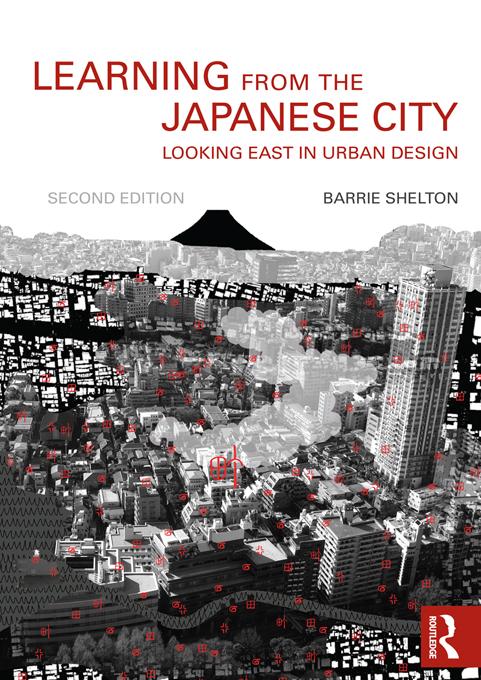
Japanese cities are amongst the most intriguing and confounding anywhere. Their structures, patterns of building and broader visual characteristics defy conventional urban design theories, and the book explores why this is so. Like its cities, Japan’s written language is recognized as one of the most complicated, and the book is unique in revealing how the two are closely related. Set perceptively against a sweep of ideas drawn from history, geography, science, cultural and design theory, Learning from the Japanese City is a highly original exploration of contemporary urbanism that crosses disciplines, scales, time and space.
This is a thoroughly revised and much extended version of a book that drew extensive praise in its first edition. Most parts have stood the test of time and remain. A few are replaced or removed; about a hundred figures appear for the first time. Most important is an entirely new (sixth) section. This brings together many of the urban characteristics, otherwise encountered in fragments through the book, in one walkable district of what is arguably Japan’s most convenient metropolis, Nagoya.
The interplay between culture, built form and cities remains at the heart of this highly readable book, while a change in subtitle to Looking East in Urban Design reflects increased emphasis on real places and design implications.
Pay easily by card, Klarna, Apple Pay or Google Pay. Not happy? You always have a 14-day money-back guarantee. Read more in our terms. If you have any questions, email us at hello@memmo.org.
Memmo makes studying easier – wherever you are in the world. We bring your course books and smart study tools together in one place: summaries, quizzes, podcasts and flashcards. Plus Ted, your study buddy who answers anything you wonder. Over 75,000 students already study here – built to help you learn faster and stress less.