
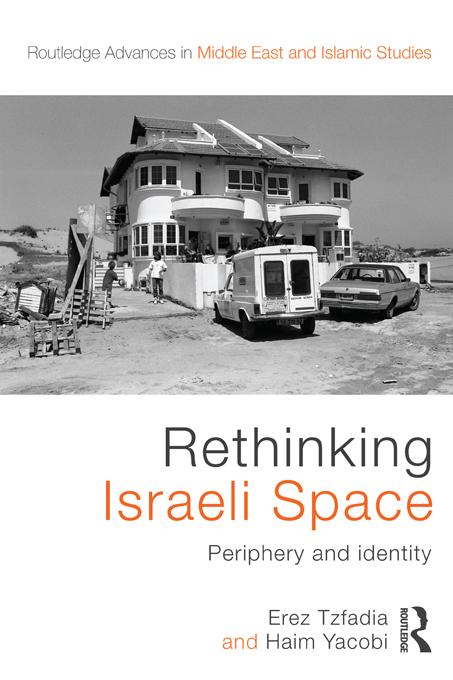
This book sheds light on the production of Israeli space and the politics of Jewish and Arab cities. The authors’ postcolonial approach deals with the notion of periphery and peripherality, covering issues of spatial protest, urban policy and urban planning.
Discussing periphery as a political, social and spatial phenomenon and both a product and a process manufactured by power mechanisms, the authors show how the state, the regime of citizenship, the capitalist logic, and the logic of ethnonationalism have all resulted in ethno-class division and stratification, which have been shaped by spatial policy. Rather than using the term periphery to describe an economic, geographical and social situation in which disadvantaged communities are located, this critical examination addresses the traditionally passive dimension of this term suggest that the reality of peripheral communities and spaces is rather more conflicted and controversial.
The multidisciplinary approach taken by this book means it will be a valuable contribution to the fields of planning theory, political science and public policy, urban sociology, critical geography and Middle East studies.
Pay easily by card, Klarna, Apple Pay or Google Pay. Not happy? You always have a 14-day money-back guarantee. Read more in our terms. If you have any questions, email us at hello@memmo.org.
Memmo makes studying easier – wherever you are in the world. We bring your course books and smart study tools together in one place: summaries, quizzes, podcasts and flashcards. Plus Ted, your study buddy who answers anything you wonder. Over 75,000 students already study here – built to help you learn faster and stress less.