
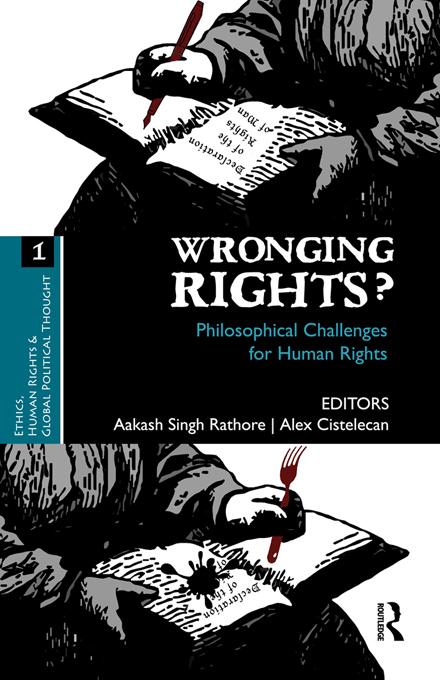
This book brings together two of the most powerful and relevant philosophical critiques of human rights: the post-colonialist and the post-Althusserian, its balanced internal structure not just throwing these two critiques together, but actually forcing them to enter into confrontation and dialogue.
The book is organised in three parts: at each end, the post-colonialist and the post-Althusserian critiques are represented by some of their main thinkers (Ratna Kapur, G. C. Spivak, Upendra Baxi; Slavoj Žižek, Jacques Rancière), while in the middle, an American intermezzo (Richard Rorty, Wendy Brown) functions as a genuine Derridian supplement: always already contaminating the purity of the two theoretical schools, preventing their enclosure and, hence, fuelling and complicating further their mutual confrontation. As in any authentic dialogue, the introduction and the conclusion each claim victory for one of the sides by changing the very terms and rules of the dialogue, picturing it as a confrontation between emancipatory universalism and inefficient particularism (from the perspective of the post-Althusserians), or as a split between hypocrisy and truth (from the perspective of the post-colonialists).
Pay easily by card, Klarna, Apple Pay or Google Pay. Not happy? You always have a 14-day money-back guarantee. Read more in our terms. If you have any questions, email us at hello@memmo.org.
Memmo makes studying easier – wherever you are in the world. We bring your course books and smart study tools together in one place: summaries, quizzes, podcasts and flashcards. Plus Ted, your study buddy who answers anything you wonder. Over 50,000 students already study here – built to help you learn faster and stress less.