
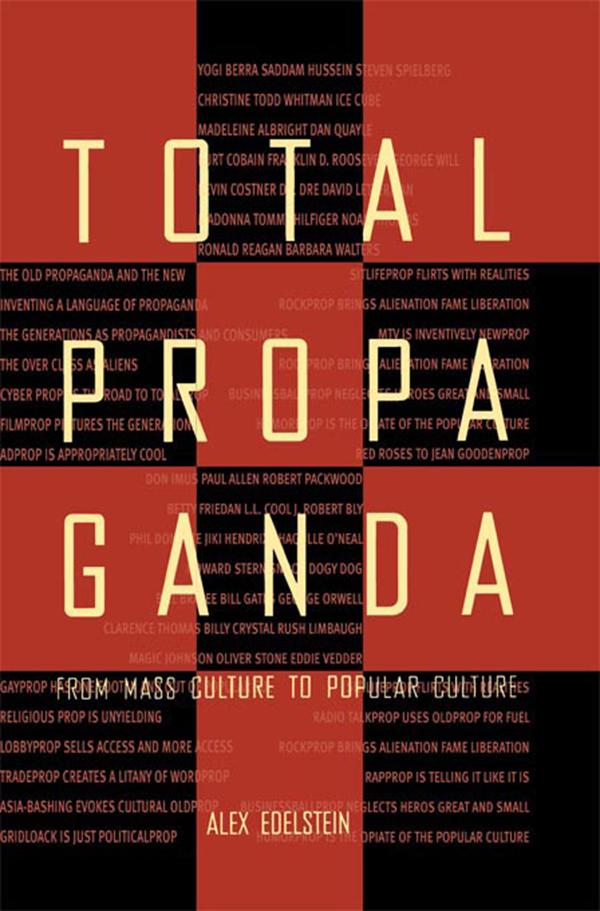
Total Propaganda moves the study of propaganda out of the exclusive realm of world politics into the more inclusive study of popular culture, media, and politics. All the participatory functioning elements of the society are aspects of membership in the popular culture. Thus, the values of popular music, media, politics, debates over social issues, and even international trade become everyday propaganda to which everyone may relate.
To emphasize the necessity for new thinking about propaganda, Edelstein creates the concepts of the new propaganda and the old, and he devises a language of "uninyms" to convey their meanings more quickly. "Oldprop" is characteristic of mass cultures and utilizes totalitarian methods of conflict, hegemony, minimization, demonization, and exclusiveness to achieve its goals. By contrast, "newprop" is created by members of the popular culture to allow them to engage in accomodation, enhance the individual, and promote inclusiveness. Shifts in the old and the new propaganda are tracked across social issues such as race, religion, sexuality, gender, gun control, and the environment, as well as in fashion, politics, advertising, sports, media, and politics.
Central to the concept of total propaganda is that it is not simply additive; it is the product of new energies that are produced by the fusing of propaganda in such related forums as music, art, advertising, sports and politics. It is these synergies, and their production of new energies, that make total propaganda greater than the sum of its parts.
Edelstein concludes that the most important distinction that should be drawn between mass culture and popular culture is its text; i.e., its propaganda. In a popular culture, everyone creates and consumes propaganda; in a mass culture almost everyone consumes it but only a few create it. This formulation offers new ways to discuss power and ideology in media texts. As an example, where once the least informed and the least educated were the most subject to propaganda, now the most informed and most educated often are the first to create propaganda and the first to consume it.
Pay easily by card, Klarna, Apple Pay or Google Pay. Not happy? You always have a 14-day money-back guarantee. Read more in our terms. If you have any questions, email us at hello@memmo.org.
Memmo makes studying easier – wherever you are in the world. We bring your course books and smart study tools together in one place: summaries, quizzes, podcasts and flashcards. Plus Ted, your study buddy who answers anything you wonder. Over 50,000 students already study here – built to help you learn faster and stress less.