
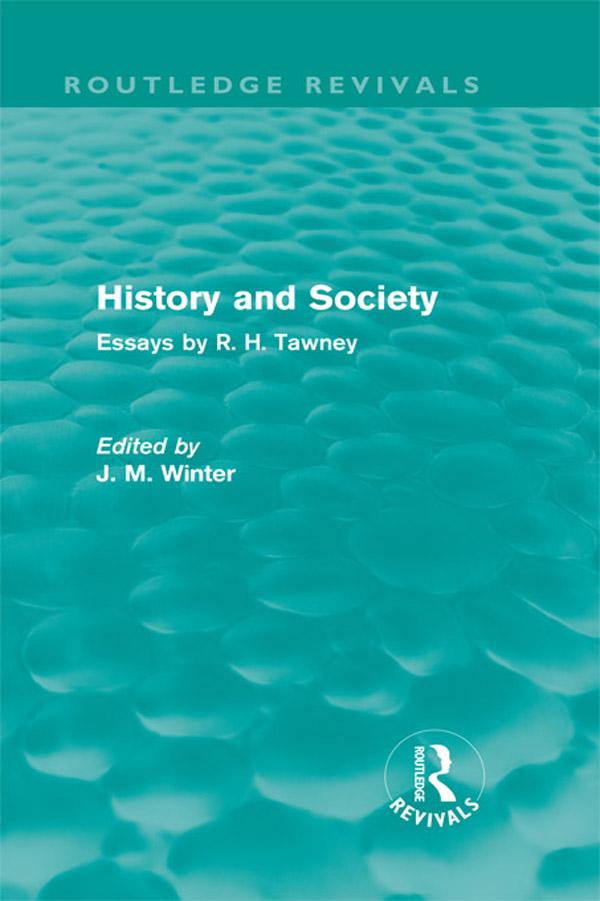
R. H. Tawney believed that the subject of economic history raises questions which touch the fundamental concerns of all thinking people. By setting economic development firmly within the framework of cultural and political life, he provided an alternative to the recent fragmentation of economic history into a number of increasingly technical specialisms.
First published as a collection in 1978, these ten essays, spanning the length of Professor Tawney’s career remain as controversial and potent as ever, and the original introduction by J. M. Winter provides the first full evaluation and significance of R. H. Tawney’s approach to economic history. Among the essays included in this volume are the indispensible studies of ‘The Rise of the Gentry’ and ‘Harrington’s Interpretation of His Age’, as well as ‘The Abolition of Economic Controls, 1918-1921’, here published in full for the first time. Other selections, such as Tawney’s celebrated inaugural lecture as Professor of Economic History at the London School of Economics in 1933, ‘the Study of Economic History’, offer a representative sample of the range and sweep of Tawney’s historical imagination. Taken together, these essays demonstrate the validity of Tawney’s conviction that economic historians must confront not only the creation of wealth, but also the moral questions surrounding its distribution.
Pay easily by card, Klarna, Apple Pay or Google Pay. Not happy? You always have a 14-day money-back guarantee. Read more in our terms. If you have any questions, email us at hello@memmo.org.
Memmo makes studying easier – wherever you are in the world. We bring your course books and smart study tools together in one place: summaries, quizzes, podcasts and flashcards. Plus Ted, your study buddy who answers anything you wonder. Over 50,000 students already study here – built to help you learn faster and stress less.