
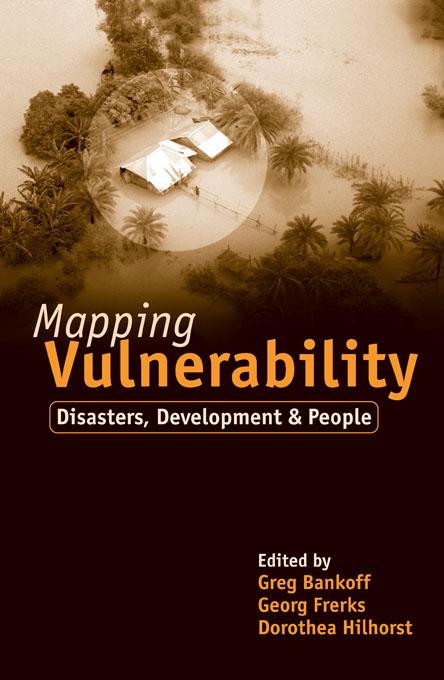
Raging floods, massive storms and cataclysmic earthquakes: every year up to 340 million people are affected by these and other disasters, which cause loss of life and damage to personal property, agriculture, and infrastructure. So what can be done? The key to understanding the causes of disasters and mitigating their impacts is the concept of 'vulnerability'.
Mapping Vulnerability analyses 'vulnerability' as a concept central to the way we understand disasters and their magnitude and impact. Written and edited by a distinguished group of disaster scholars and practitioners, this book is a counterbalance to those technocratic approaches that limit themselves to simply looking at disasters as natural phenomena. Through the notion of vulnerability, the authors stress the importance of social processes and human-environmental interactions as causal agents in the making of disasters. They critically examine what renders communities unsafe - a condition, they argue, that depends primarily on the relative position of advantage or disadvantage that a particular group occupies within a society's social order. The book also looks at vulnerability in terms of its relationship to development and its impact on policy and people's lives, through consideration of selected case studies drawn from Africa, Asia and Latin America. Mapping Vulnerability is essential reading for academics, students, policymakers and practitioners in disaster studies, geography, development studies, economics, environmental studies and sociology.
Pay easily by card, Klarna, Apple Pay or Google Pay. Not happy? You always have a 14-day money-back guarantee. Read more in our terms. If you have any questions, email us at hello@memmo.org.
Memmo makes studying easier – wherever you are in the world. We bring your course books and smart study tools together in one place: summaries, quizzes, podcasts and flashcards. Plus Ted, your study buddy who answers anything you wonder. Over 50,000 students already study here – built to help you learn faster and stress less.