
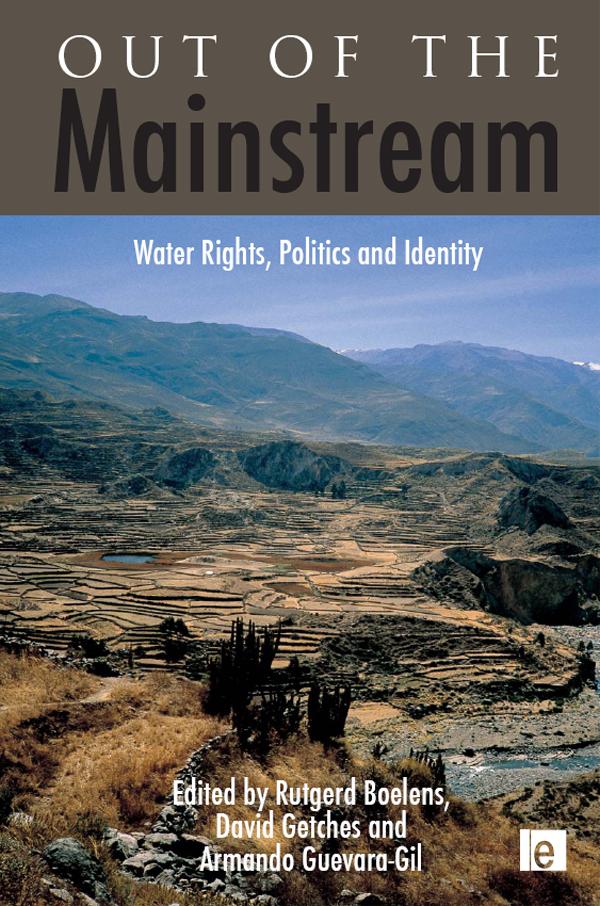
Water is not only a source of life and culture. It is also a source of power, conflicting interests and identity battles. Rights to materially access, culturally organize and politically control water resources are poorly understood by mainstream scientific approaches and hardly addressed by current normative frameworks. These issues become even more challenging when law and policy-makers and dominant power groups try to grasp, contain and handle them in multicultural societies. The struggles over the uses, meanings and appropriation of water are especially well-illustrated in Andean communities and local water systems of Peru, Chile, Ecuador, and Bolivia, as well as in Native American communities in south-western USA. The problem is that throughout history, these nation-states have attempted to 'civilize' and bring into the mainstream the different cultures and peoples within their borders instead of understanding 'context' and harnessing the strengths and potentials of diversity. This book examines the multi-scale struggles for cultural justice and socio-economic re-distribution that arise as Latin American communities and user federations seek access to water resources and decision-making power regarding their control and management. It is set in the dynamic context of unequal, globalizing power relations, politics of scale and identity, environmental encroachment and the increasing presence of extractive industries that are creating additional pressures on local livelihoods.
While much of the focus of the book is on the Andean Region, a number of comparative chapters are also included. These address issues such as water rights and defence strategies in neighbouring countries and those of Native American people in the southern USA, as well as state reform and multi-culturalism across Latin and Native America and the use of international standards in struggles for indigenous water rights. This book shows that, against all odds, people are actively contesting neoliberal globalization and water power plays. In doing so, they construct new, hybrid water rights systems, livelihoods, cultures and hydro-political networks, and dynamically challenge the mainstream powers and politics.
Pay easily by card, Klarna, Apple Pay or Google Pay. Not happy? You always have a 14-day money-back guarantee. Read more in our terms. If you have any questions, email us at hello@memmo.org.
Memmo makes studying easier – wherever you are in the world. We bring your course books and smart study tools together in one place: summaries, quizzes, podcasts and flashcards. Plus Ted, your study buddy who answers anything you wonder. Over 50,000 students already study here – built to help you learn faster and stress less.