
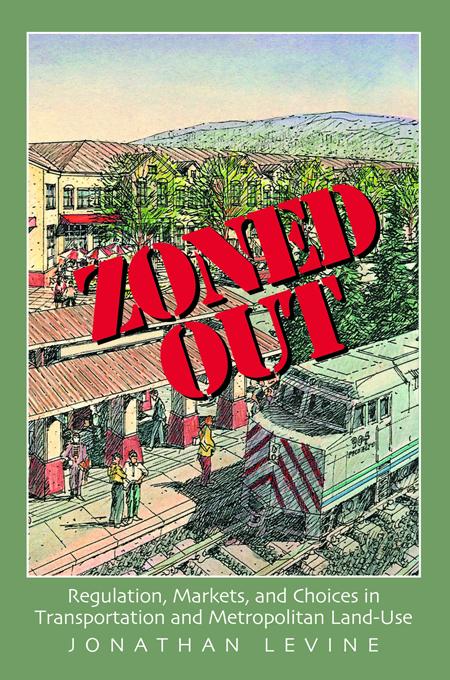
Researchers have responded to urban sprawl, congestion, and pollution by assessing alternatives such as smart growth, new urbanism, and transit-oriented development. Underlying this has been the presumption that, for these options to be given serious consideration as part of policy reform, science has to prove that they will reduce auto use and increase transit, walking, and other physical activity. Zoned Out forcefully argues that the debate about transportation and land-use planning in the United States has been distorted by a myth?the myth that urban sprawl is the result of a free market. According to this myth, low-density, auto-dependent development dominates U.S. metropolitan areas because that is what Americans prefer. Jonathan Levine confronts the free market myth by pointing out that land development is already one of the most regulated sectors of the U.S. economy. Noting that local governments use their regulatory powers to lower densities, segregate different types of land uses, and mandate large roadways and parking lots, he argues that the design template for urban sprawl is written into the land-use regulations of thousands of municipalities nationwide. These regulations and the skewed thinking that underlies current debate mean that policy innovation, market forces, and the compact-development alternatives they might produce are often 'zoned out' of metropolitan areas.
In debunking the market myth, Levine articulates an important paradigm shift. Where people believe that current land-use development is governed by a free-market, any proposal for policy reform is seen as a market intervention and a limitation on consumer choice, and any proposal carries a high burden of scientific proof that it will be effective. By reorienting the debate, Levine shows that the burden of scientific proof that was the lynchpin of transportation and land-use debates has been misassigned, and that, far from impeding market forces or limiting consumer choice, policy reform that removes regulatory obstacles would enhance both. A groundbreaking work in urban planning, transportation and land-use policy, Zoned Out challenges a policy environment in which scientific uncertainty is used to reinforce the status quo of sprawl and its negative consequences for people and their communities.
Pay easily by card, Klarna, Apple Pay or Google Pay. Not happy? You always have a 14-day money-back guarantee. Read more in our terms. If you have any questions, email us at hello@memmo.org.
Memmo makes studying easier – wherever you are in the world. We bring your course books and smart study tools together in one place: summaries, quizzes, podcasts and flashcards. Plus Ted, your study buddy who answers anything you wonder. Over 75,000 students already study here – built to help you learn faster and stress less.