
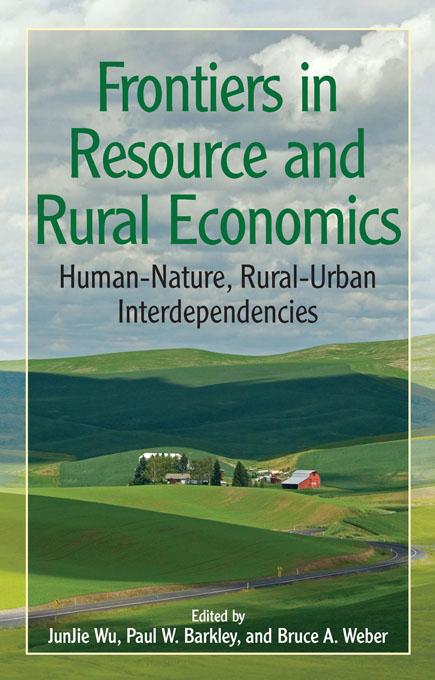
Most land in the United States is in rural areas, as are the sources of most of its fresh water and almost all its other natural resources. One of the first books to approach resource economics and rural studies as fundamentally interconnected areas of study, Frontiers in Resource and Rural Economics integrates the work of 18 leading scholars in resource economics, rural economics, rural sociology and political science in order to focus on two complex interdependencies-one pertaining to natural resources and human welfare, the other to urban and rural communities and their economies.
The book reviews the past 50 years of scholarship in both natural resource and rural economics. It contrasts their different intellectual and practical approaches and considers how they might be refocused in light of pressing demands on human and natural systems. It then proposes a 'new rural economics' that acknowledges the full range of human-ecosystem and urban-rural interdependencies. It explores the relationship between natural resources and economic growth, and considers the prospects for amenity-driven growth that would benefit both new and traditional inhabitants of rural areas. Later chapters explore the politics of place, spatial economics, strategies for reducing rural poverty, and prospects for linking rural and environmental governance. Throughout, the book emphasizes innovative research methods that integrate natural resource, environmental, and rural economics.
Pay easily by card, Klarna, Apple Pay or Google Pay. Not happy? You always have a 14-day money-back guarantee. Read more in our terms. If you have any questions, email us at hello@memmo.org.
Memmo makes studying easier – wherever you are in the world. We bring your course books and smart study tools together in one place: summaries, quizzes, podcasts and flashcards. Plus Ted, your study buddy who answers anything you wonder. Over 50,000 students already study here – built to help you learn faster and stress less.