
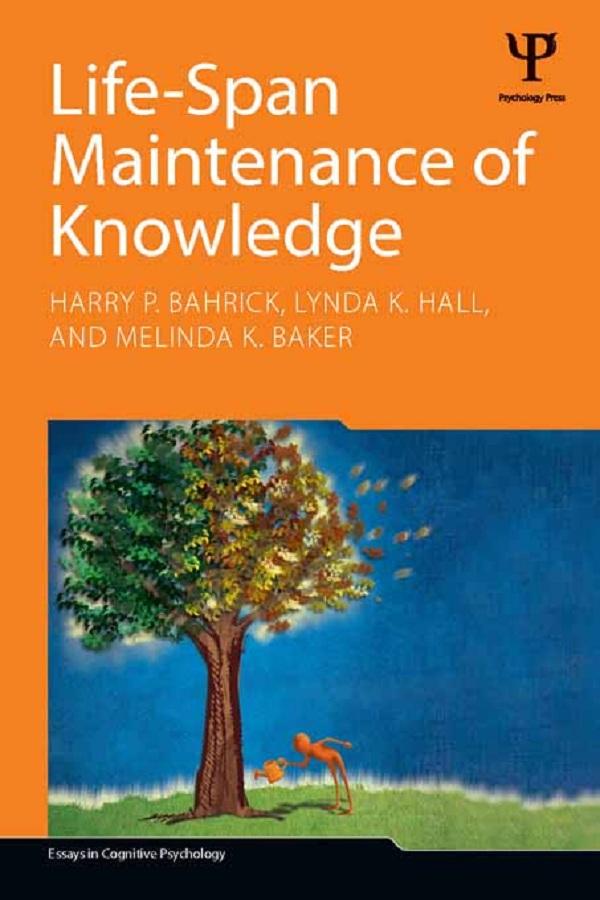
This volume describes how well we maintain the knowledge we acquire throughout life. Research traditionally focuses on memory for events that are retained over short time periods that can be accommodated in experiments. This book, by contrast, uniquely describes the evolution of methods suitable for investigating memory of complex knowledge acquired over several years and retained during the entire life-span. The methods substitute statistical for experimental controls, and the investigations involve several hundred participants whose memory is tested up to 50 years after they acquired the knowledge in question.
The book covers educational content, such as mathematics and foreign languages; knowledge acquired incidentally, such as the streets and buildings of the cities in which we live; and knowledge acquired through the media. Previously unpublished research on age-related access to knowledge is included.
The analyses are based on the accessibility/availability ratio, a metric presented for the first time. This metric allows comparisons of the portion of available knowledge that can be recalled as a function of age, education and other individual differences, and as a function of the domain of knowledge in question. The ratio can be used to evaluate methods of instruction and methods of studying. It can also be used to evaluate memory development and to diagnose memory pathology.
The volume will be of interest to researchers in human memory, developmental psychologists, gerontologists in academic and applied settings, and educators.
Pay easily by card, Klarna, Apple Pay or Google Pay. Not happy? You always have a 14-day money-back guarantee. Read more in our terms. If you have any questions, email us at hello@memmo.org.
Memmo makes studying easier – wherever you are in the world. We bring your course books and smart study tools together in one place: summaries, quizzes, podcasts and flashcards. Plus Ted, your study buddy who answers anything you wonder. Over 50,000 students already study here – built to help you learn faster and stress less.