
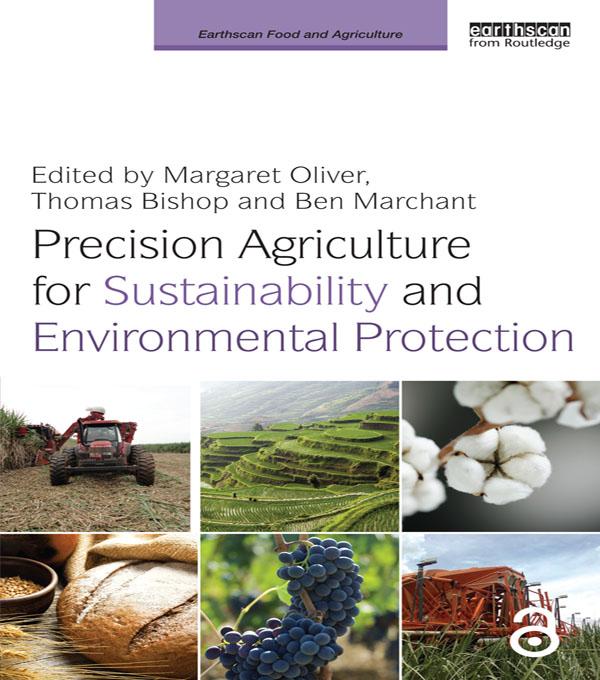
Precision agriculture (PA) involves the application of technologies and agronomic principles to manage spatial and temporal variation associated with all aspects of agricultural production in order to improve crop performance and environmental quality. The focus of this book is to introduce a non-specialist audience to the the role of PA in food security, environmental protection, and sustainable use of natural resources, as well as its economic benefits.
The technologies covered include yield monitors and remote sensing, and the key agronomic principles addressed are the optimal delivery of fertilizers, water and pesticides to crops only when and where these are required. As a result, it is shown that both food production and resource efficiency can be maximized, without waste or damage to the environment, such as can occur from excessive fertilizer or pesticide applications. The authors of necessity describe some technicalities about PA, but the overall aim is to introduce readers who are unfamiliar with PA to this very broad subject and to demonstrate the potential impact of PA on the environment and economy.
Chapter 3 of this book is freely available as a downloadable Open Access PDF at http://www.taylorfrancis.com under a Creative Commons Attribution-Non Commercial-No Derivatives (CC-BY-NC-ND) 3.0 license.
Pay easily by card, Klarna, Apple Pay or Google Pay. Not happy? You always have a 14-day money-back guarantee. Read more in our terms. If you have any questions, email us at hello@memmo.org.
Memmo makes studying easier – wherever you are in the world. We bring your course books and smart study tools together in one place: summaries, quizzes, podcasts and flashcards. Plus Ted, your study buddy who answers anything you wonder. Over 50,000 students already study here – built to help you learn faster and stress less.