
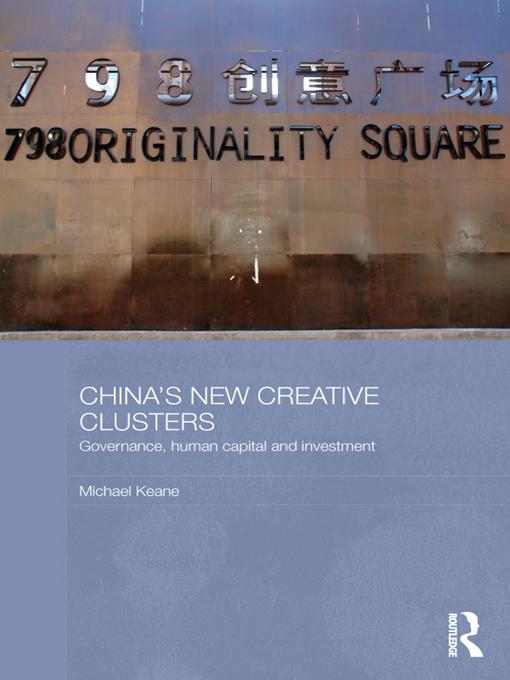
Recognising that creativity is a major driving force in the post-industrial economy, the Chinese government has recently established a range of "creative clusters" – industrial parks devoted to media industries, and arts districts – in order to promote the development of the creative industries. This book examines these new creative clusters, outlining their nature and purpose, and assessing their effectiveness. Drawing on case studies of a range of cluster models, and comparing them with international examples, the book demonstrates that creativity, both in China and internationally, is in fact a process of fitting new ideas to existing patterns, models and formats. It shows how large and exceptionally impressive creative clusters have been successfully established, but raises the important questions of whether profit or culture is the driving force, and of whether the bringing together of independent-minded, creative people, entrepreneurial businessmen, preferential policies and foreign investment may in time lead to unintended changes in social and political attitudes in China, including a weakening of state bureaucratic power. An important contribution to the existing literature on the subject, this book will be of great interest to scholars of urban studies, cultural geography, cultural economics and Asian studies.
Pay easily by card, Klarna, Apple Pay or Google Pay. Not happy? You always have a 14-day money-back guarantee. Read more in our terms. If you have any questions, email us at hello@memmo.org.
Memmo makes studying easier – wherever you are in the world. We bring your course books and smart study tools together in one place: summaries, quizzes, podcasts and flashcards. Plus Ted, your study buddy who answers anything you wonder. Over 75,000 students already study here – built to help you learn faster and stress less.