
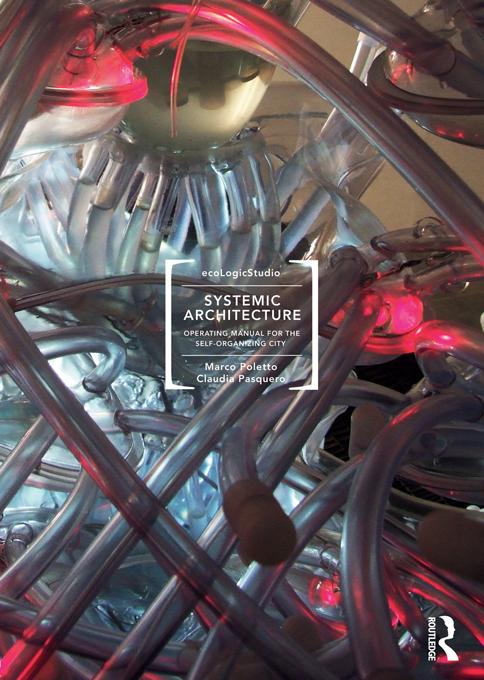
This is a manual investigating the subject of urban ecology and systemic development from the perspective of architectural design. It sets out to explore two main goals: to discuss the contemporary relevance of a systemic practice to architectural design, and to share a toolbox of informational design protocols developed to describe the city as a territory of self-organization.
Collecting together nearly a decade of design experiments by the authors and their practice, ecoLogicStudio, the book discusses key disciplinary definitions such as ecologic urbanism, algorithmic architecture, bottom-up or tactical design, behavioural space and the boundary of the natural and the artificial realms within the city and architecture.
A new kind of "real-time world-city" is illustrated in the form of an operational design manual for the assemblage of proto-architectures, the incubation of proto-gardens and the coding of proto-interfaces. These prototypes of machinic architecture materialize as synthetic hybrids embedded with biological life (proto-gardens), computational power, behavioural responsiveness (cyber-gardens), spatial articulation (coMachines and fibrous structures), remote sensing (FUNclouds), and communication capabilities (Ecological Footprint Grotto).
Supporting the authors’ own essays and projects are contributions from key innovators in contemporary architecture and urban design: Michael Batty, Andrew Hudson-Smith, Michael Weinstock and Patrik Schumacher.
Pay easily by card, Klarna, Apple Pay or Google Pay. Not happy? You always have a 14-day money-back guarantee. Read more in our terms. If you have any questions, email us at hello@memmo.org.
Memmo makes studying easier – wherever you are in the world. We bring your course books and smart study tools together in one place: summaries, quizzes, podcasts and flashcards. Plus Ted, your study buddy who answers anything you wonder. Over 75,000 students already study here – built to help you learn faster and stress less.