
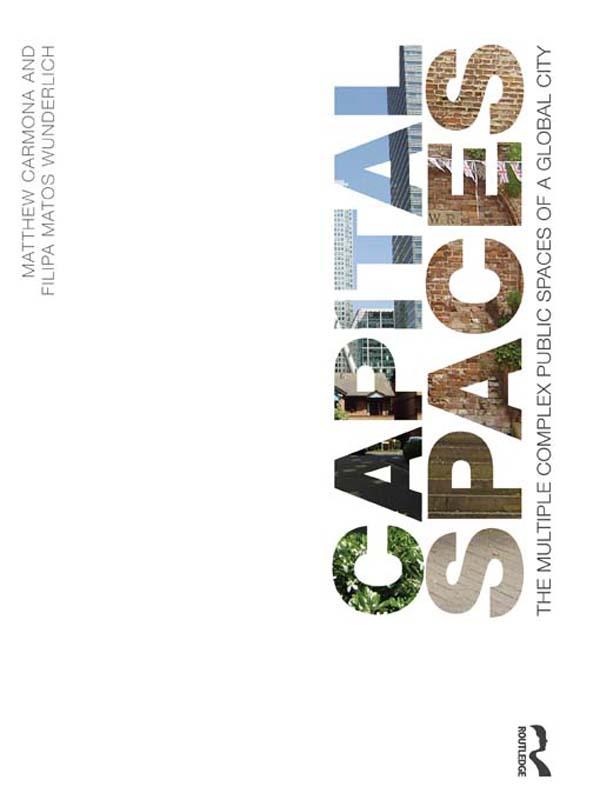
In recent years it has become common-place to hear claims that public space in cities across the globe has become the exclusive preserve of the wealthy and privileged, at the expense of the needs of wider society. Whether it is the privatization of public space through commerical developments like shopping malls and business parks, the gentrification of existing spaces by campaigns against perceived anti-social behaviour or the increasing domination of public areas by private transport in the form of the car, the urban public space is seen as under threat.
But are things really that bad? Has the market really become the sole factor that influences the treatment of public space? Have the financial and personal interests of the few really come to dominate those of the many?
To answer these questions Matthew Carmona and Filipa Wunderlich have carried out a detailed investigation of the modern public spaces of London, that most global of cities. They have developed a new typology of public spaces applicable to all cities, a typology that demonstrates that to properly assess contemporary urban places means challenging the over-simplification of current critiques. Global cities are made up of many overlapping public spaces, good and bad; this book shows how to analyze this complexity, and to understand it.
Pay easily by card, Klarna, Apple Pay or Google Pay. Not happy? You always have a 14-day money-back guarantee. Read more in our terms. If you have any questions, email us at hello@memmo.org.
Memmo makes studying easier – wherever you are in the world. We bring your course books and smart study tools together in one place: summaries, quizzes, podcasts and flashcards. Plus Ted, your study buddy who answers anything you wonder. Over 75,000 students already study here – built to help you learn faster and stress less.