
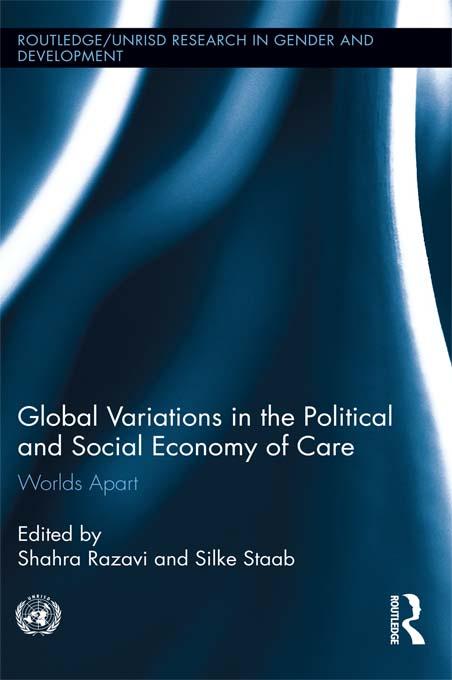
Care work, both paid and unpaid, contributes to well-being, social development and economic growth. But the costs of providing care are unequally borne across gender and social class. Feminist scholarship on the gendered construction of welfare provisioning and welfare regimes has produced a conceptually strong and empirically grounded analysis of care, reinforcing the necessity of rethinking the distinctions between "the public" and "the private" as well as the links between them. Yet this analysis, premised on post-industrial contexts, does not travel easily to other parts of the world. Many of its core assumptions – about family structures, labor markets, state capacities, and public social provisioning – do not hold for a wider range of countries. Drawing on original research on the care economy in three developing regions (Africa, Asia, Latin America), this volume addresses a major empirical lacuna while facilitating a conversation across the North-South divide.
Pay easily by card, Klarna, Apple Pay or Google Pay. Not happy? You always have a 14-day money-back guarantee. Read more in our terms. If you have any questions, email us at hello@memmo.org.
Memmo makes studying easier – wherever you are in the world. We bring your course books and smart study tools together in one place: summaries, quizzes, podcasts and flashcards. Plus Ted, your study buddy who answers anything you wonder. Over 50,000 students already study here – built to help you learn faster and stress less.