
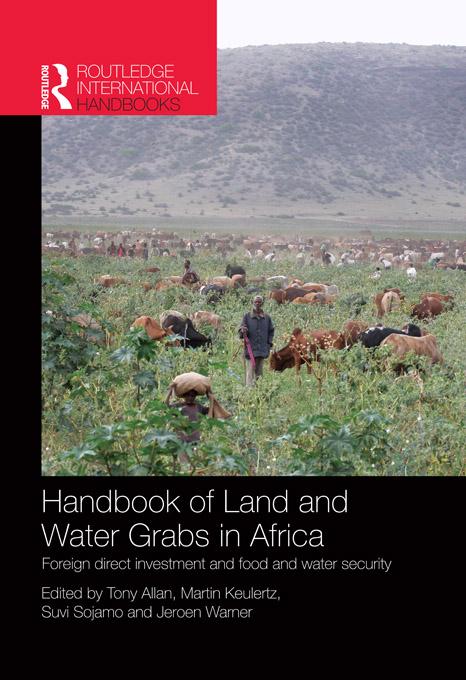
According to estimates by the International Land Coalition based at the International Fund for Agricultural Development (IFAD), 57 million hectares of land have been leased to foreign investors since 2007. Current research has focused on human rights issues related to inward investment in land but has been ignorant of water resource issues and the challenges of managing scarce water. This handbook will be the first to address inward investment in land and its impact on water resources in Africa.
The geographical scope of this book will be the African continent, where land has attracted the attention of risk-taking investors because much land is under-utilised marginalized land, with associated water resources and rapidly growing domestic food markets. The successful implementation of investment strategies in African agriculture could determine the future of more than one billion people. An important factor to note is that Sub-Saharan Africa will, of all the continents, be hit hardest by climate change, population growth and food insecurity. Sensible investment in agriculture is therefore needed, however, at what costs and at whose expense?
The book will also address the livelihoods theme and provide a holistic analysis of land and water grabbing in Sub-Saharan Africa. Four other themes will addressed: politics, economics, environment and the history of land investments in Sub-Saharan Africa.
The editors have involved a highly diverse group of around 25 expert researchers, who will review the pro and anti-investment arguments, geopolitics, the role of capitalist investors, the environmental contexts and the political implications of, and reasons for, leasing millions of hectares in Sub-Saharan Africa. To date, there has been no attempt to review land investments through a suite of different lenses, thus this handbook will differ significantly from existing research and publication.
The editors are Tony Allan, (Professor Emeritus, Department of Geography, School of Oriental and African Studies and King’s College London); Jeroen Warner (Assistant Professor, Disaster Studies, University of Wageningen); Suvi Sojamo (PhD Researcher, Water and Development Research Group, Aalto University); and Martin Keulertz (PhD Researcher, Department of Geography, London Water Group, King’s College London).
Pay easily by card, Klarna, Apple Pay or Google Pay. Not happy? You always have a 14-day money-back guarantee. Read more in our terms. If you have any questions, email us at hello@memmo.org.
Memmo makes studying easier – wherever you are in the world. We bring your course books and smart study tools together in one place: summaries, quizzes, podcasts and flashcards. Plus Ted, your study buddy who answers anything you wonder. Over 50,000 students already study here – built to help you learn faster and stress less.