
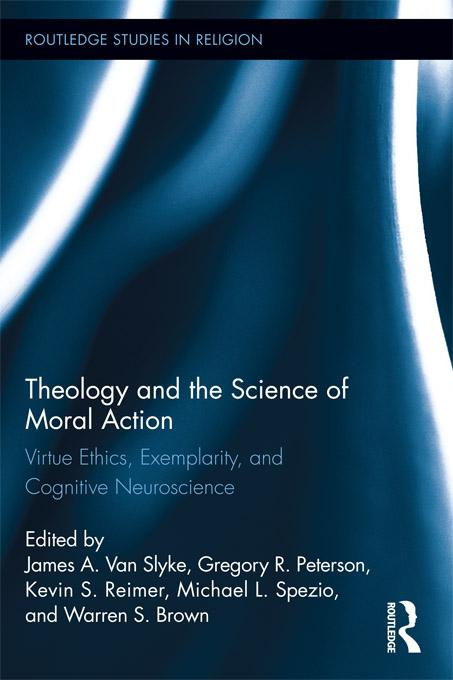
The past decade has witnessed a renaissance in scientific approaches to the study of morality. Once understood to be the domain of moral psychology, the newer approach to morality is largely interdisciplinary, driven in no small part by developments in behavioural economics and evolutionary biology, as well as advances in neuroscientific imaging capabilities, among other fields. To date, scientists studying moral cognition and behaviour have paid little attention to virtue theory, while virtue theorists have yet to acknowledge the new research results emerging from the new science of morality.
Theology and the Science of Moral Action explores a new approach to ethical thinking that promotes dialogue and integration between recent research in the scientific study of moral cognition and behaviour—including neuroscience, moral psychology, and behavioural economics—and virtue theoretic approaches to ethics in both philosophy and theology. More particularly, the book evaluates the concept of moral exemplarity and its significance in philosophical and theological ethics as well as for ongoing research programs in the cognitive sciences.
Pay easily by card, Klarna, Apple Pay or Google Pay. Not happy? You always have a 14-day money-back guarantee. Read more in our terms. If you have any questions, email us at hello@memmo.org.
Memmo makes studying easier – wherever you are in the world. We bring your course books and smart study tools together in one place: summaries, quizzes, podcasts and flashcards. Plus Ted, your study buddy who answers anything you wonder. Over 50,000 students already study here – built to help you learn faster and stress less.