
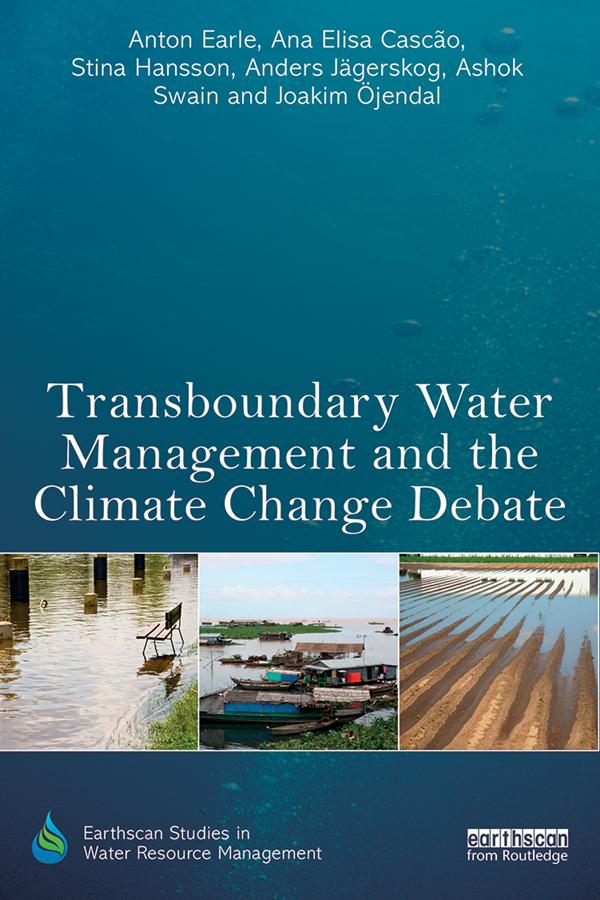
Climate change has an impact on the ability of transboundary water management institutions to deliver on their respective mandates. The starting point for this book is that actors within transboundary water management institutions develop responses to the climate change debate, as distinct from the physical phenomenon of climate change. Actors respond to this debate broadly in three distinct ways – adapt, resist (as in avoiding the issue) and subvert (as in using the debate to fulfil their own agenda).
The book charts approaches which have been taken over the past two decades to promote more effective water management institutions, covering issues of conflict, cooperation, power and law. A new framework for a better understanding of the interaction between transboundary water management institutional resilience and global change is developed through analysis of the way these institutions respond to the climate change debate. This framework is applied to six river case studies from Africa, Asia and the Middle East (Ganges-Brahmaputra, Jordan, Mekong, Niger, Nile, Orange-Senqu) from which learning conclusions and policy recommendations are developed.
Pay easily by card, Klarna, Apple Pay or Google Pay. Not happy? You always have a 14-day money-back guarantee. Read more in our terms. If you have any questions, email us at hello@memmo.org.
Memmo makes studying easier – wherever you are in the world. We bring your course books and smart study tools together in one place: summaries, quizzes, podcasts and flashcards. Plus Ted, your study buddy who answers anything you wonder. Over 50,000 students already study here – built to help you learn faster and stress less.