
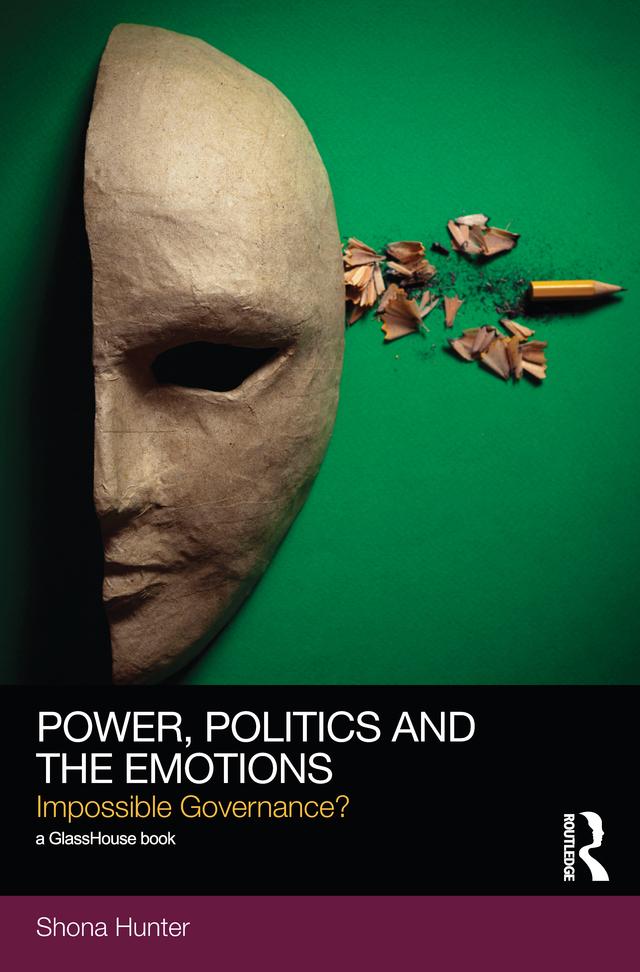
How can we rethink ideas of policy failure to consider its paradoxes and contradictions as a starting point for more hopeful democratic encounters?
Offering a provocative and innovative theorisation of governance as relational politics, the central argument of Power, Politics and the Emotions is that there are sets of affective dynamics which complicate the already materially and symbolically contested terrain of policy-making. This relational politics is Shona Hunter’s starting point for a more hopeful, but realistic understanding of the limits and possibilities enacted through contemporary governing processes. Through this idea Hunter prioritises the everyday lived enactments of policy as a means to understand the state as a more differentiated and changeable entity than is often allowed for in current critiques of neoliberalism. But Hunter reminds us that focusing on lived realities demands a melancholic confrontation with pain, and the risks of social and physical death and violence lived through the contemporary neoliberal state. This is a state characterised by the ascendency of neoliberal whiteness; a state where no one is innocent and we are all responsible for the multiple intersecting exclusionary practices creating its unequal social orderings. The only way to struggle through the central paradox of governance to produce something different is to accept this troubling interdependence between resistance and reproduction and between hope and loss.
Analysing the everyday processes of this relational politics through original empirical studies in health, social care and education the book develops an innovative interdisciplinary theoretical synthesis which engages with and extends work in political science, cultural theory, critical race and feminist analysis, critical psychoanalysis and post-material sociology.
Pay easily by card, Klarna, Apple Pay or Google Pay. Not happy? You always have a 14-day money-back guarantee. Read more in our terms. If you have any questions, email us at hello@memmo.org.
Memmo makes studying easier – wherever you are in the world. We bring your course books and smart study tools together in one place: summaries, quizzes, podcasts and flashcards. Plus Ted, your study buddy who answers anything you wonder. Over 50,000 students already study here – built to help you learn faster and stress less.