
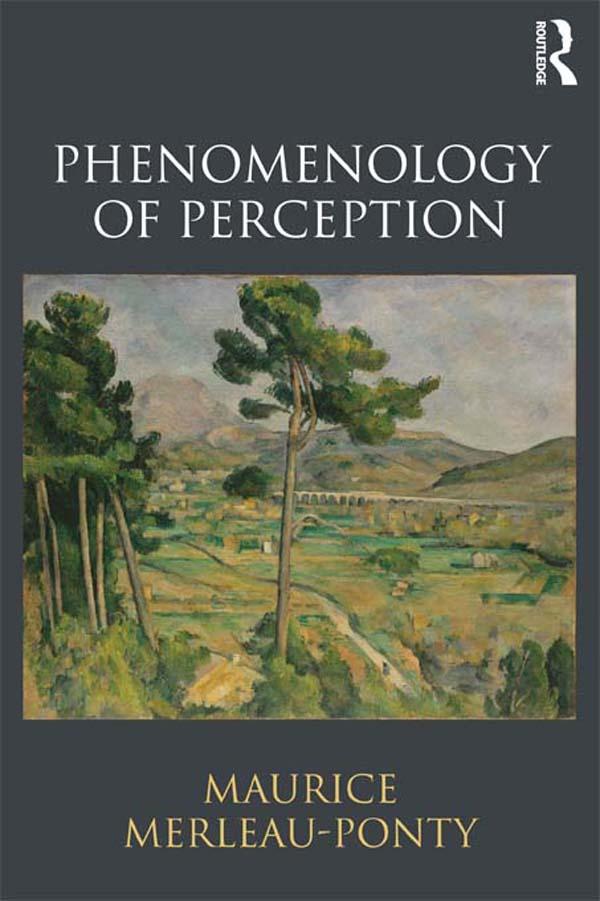
First published in 1945, Maurice Merleau-Ponty’s monumental Phénoménologie de la perception signalled the arrival of a major new philosophical and intellectual voice in post-war Europe. Breaking with the prevailing picture of existentialism and phenomenology at the time, it has become one of the landmark works of twentieth-century thought. This new translation, the first for over fifty years, makes this classic work of philosophy available to a new generation of readers.
Phenomenology of Perception stands in the great phenomenological tradition of Husserl, Heidegger, and Sartre. Yet Merleau-Ponty’s contribution is decisive, as he brings this tradition and other philosophical predecessors, particularly Descartes and Kant, to confront a neglected dimension of our experience: the lived body and the phenomenal world. Charting a bold course between the reductionism of science on the one hand and "intellectualism" on the other, Merleau-Ponty argues that we should regard the body not as a mere biological or physical unit, but as the body which structures one’s situation and experience within the world.
Merleau-Ponty enriches his classic work with engaging studies of famous cases in the history of psychology and neurology as well as phenomena that continue to draw our attention, such as phantom limb syndrome, synaesthesia, and hallucination. This new translation includes many helpful features such as the reintroduction of Merleau-Ponty’s discursive Table of Contents as subtitles into the body of the text, a comprehensive Translator’s Introduction to its main themes, essential notes explaining key terms of translation, an extensive Index, and an important updating of Merleau-Ponty’s references to now available English translations.
Also included is a new foreword by Taylor Carman and an introduction to Merleau-Ponty by Claude Lefort.
Translated by Donald A. Landes.
Pay easily by card, Klarna, Apple Pay or Google Pay. Not happy? You always have a 14-day money-back guarantee. Read more in our terms. If you have any questions, email us at hello@memmo.org.
Memmo makes studying easier – wherever you are in the world. We bring your course books and smart study tools together in one place: summaries, quizzes, podcasts and flashcards. Plus Ted, your study buddy who answers anything you wonder. Over 50,000 students already study here – built to help you learn faster and stress less.