
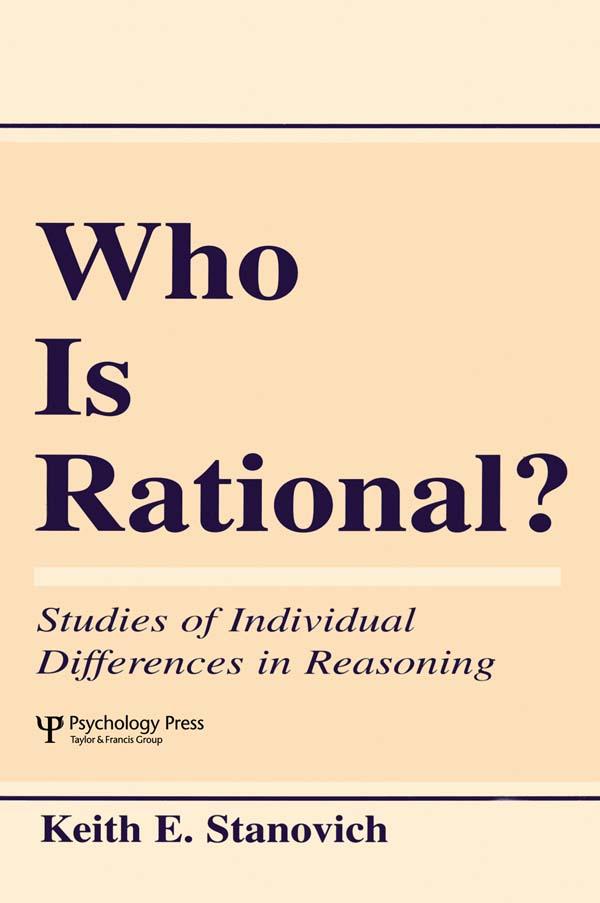
Integrating a decade-long program of empirical research with current cognitive theory, this book demonstrates that psychological research has profound implications for current debates about what it means to be rational. The author brings new evidence to bear on these issues by demonstrating that patterns of individual differences--largely ignored in disputes about human rationality--have strong implications for explanations of the gap between normative and descriptive models of human behavior. Separate chapters show how patterns of individual differences have implications for all of the major critiques of purported demonstrations of human irrationality in the heuristics and biases literature. In these critiques, it has been posited that experimenters have observed performance errors rather than systematically irrational responses; the tasks have required computational operations that exceed human cognitive capacity; experimenters have applied the wrong normative model to the task; and participants have misinterpreted the tasks.
In a comprehensive set of studies, Stanovich demonstrates that gaps between normative and descriptive models of performance on some tasks can be accounted for by positing these alternative explanations, but that not all discrepancies from normative models can be so explained. Individual differences in rational thought can in part be predicted by psychological dispositions that are interpreted as characteristic biases in people's intentional-level psychologies. Presenting the most comprehensive examination of individual differences in the heuristics and biases literature that has yet been published, experiments and theoretical insights in this volume contextualize the heuristics and biases literature exemplified in the work of various investigators.
Pay easily by card, Klarna, Apple Pay or Google Pay. Not happy? You always have a 14-day money-back guarantee. Read more in our terms. If you have any questions, email us at hello@memmo.org.
Memmo makes studying easier – wherever you are in the world. We bring your course books and smart study tools together in one place: summaries, quizzes, podcasts and flashcards. Plus Ted, your study buddy who answers anything you wonder. Over 50,000 students already study here – built to help you learn faster and stress less.