
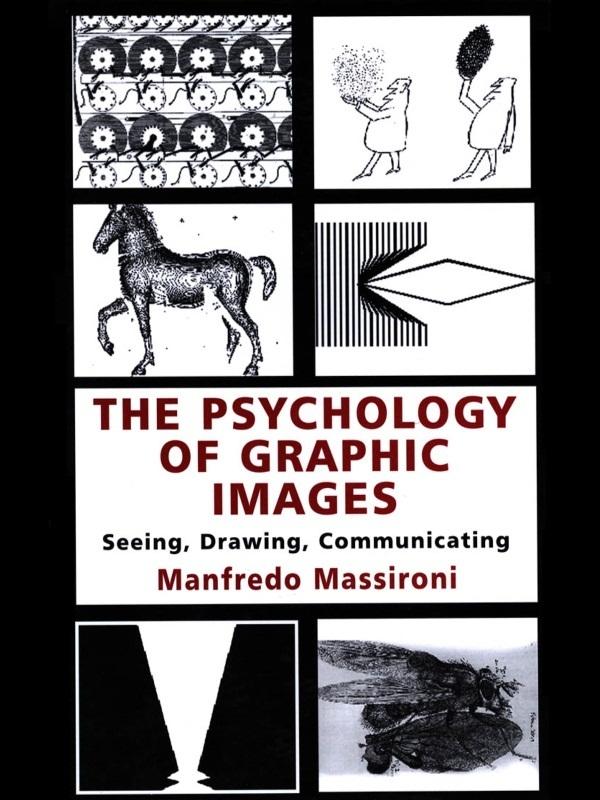
This book explores the nature of one of the most ancient tools for nonverbal communication: drawings. They are naturally adaptable enough to meet an incredibly wide range of communication needs. But how exactly do they do their job so well?
Avoiding the kinds of aesthetic rankings of different graphic domains so often made by art historians and critics, Manfredo Massironi considers an extensive and representative sample of graphic applications with an open mind. He finds a deep mutuality between the material components of images and the activation of the perceptual and cognitive processes that create and decipher them.
Massironi first examines the material components themselves: the mark or line, the plane of representation (the angle formed by the actual drawing surface and the depicted objects), and the position of the viewpoint relative to the depicted objects. The roles played by these three components are independent of the content of the drawing; they function in the same way in concrete and abstract representations. He then closely scrutinizes the choices made by the person planning and executing the drawings. Given that any object can be depicted in an infinite number of different ways, the drawer performs continuous work emphasizing and excluding different features. The choices are typically unconscious and guided by his or her communicative goals. A successful graph, be it simple or complex, is always successful precisely because the emphasized features are far fewer in number than the excluded ones. Finally, he analyzes the perceptual and cognitive integrations made by the viewer.
Drawings are not simply tools for communication but important instruments for investigating reality and its structure. Richly illustrated, the book includes a series of graphic exercises that enable readers to get a sense of their own perceptual and cognitive activity when inspecting images. Massironi's pathbreaking taxonomy of graphic productions will illuminate all the processes involved in producing and understanding graphic images for a wide audience, in fields ranging from perceptual and cognitive psychology through human factors and graphic design to architecture and art history.
Pay easily by card, Klarna, Apple Pay or Google Pay. Not happy? You always have a 14-day money-back guarantee. Read more in our terms. If you have any questions, email us at hello@memmo.org.
Memmo makes studying easier – wherever you are in the world. We bring your course books and smart study tools together in one place: summaries, quizzes, podcasts and flashcards. Plus Ted, your study buddy who answers anything you wonder. Over 50,000 students already study here – built to help you learn faster and stress less.