
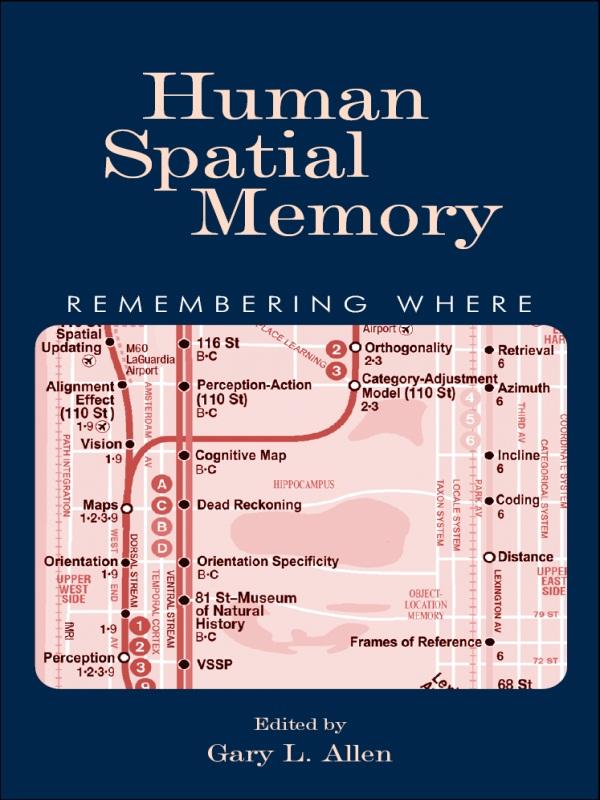
The chapters in Human Spatial Memory: Remembering Where present a fascinating picture of an everyday aspect of mental life that is as intriguing to people outside of academia as it is to scientists studying human cognition and behavior. The questions are as old as the study of mind itself: How do we remember where objects are located? How do we remember where we are in relation to other places? What is the origin and developmental course of spatial memory? What neural structures are involved in remembering where? How do we come to understand scaled-down versions of places as symbolic representations of actual places? Although the questions are old, some of the answers-in-progress are new, thanks to some innovative theorizing, solid experimental work, and revealing applications of new technologies, such as virtual environments and brain imaging techniques.
This volume includes a variety of theoretical, empirical, and methodological advances that invite readers to make their own novel connections between theory and research. Scholars who study spatial cognition can benefit from examining the latest from well-established experts, as well as milestone contributions from early-career researchers. This combination provides the reader with a sense of past, present, and future in terms of spatial memory research. Just as important, however, is the value of the volume as a touchstone resource for researchers who study perception, memory, or cognition but who are not concerned primarily with the spatial domain. All readers may find the fact that this volume violates the trend toward an ever-narrowing specialization refreshing. Chapters from cognitive psychologists are alongside chapters by developmentalists and neuroscientists; results from field studies are just pages away from those based on fMRI during observation of virtual displays. Thus, the book invites integrative examination across disciplines, research areas, and methodological approaches.
Pay easily by card, Klarna, Apple Pay or Google Pay. Not happy? You always have a 14-day money-back guarantee. Read more in our terms. If you have any questions, email us at hello@memmo.org.
Memmo makes studying easier – wherever you are in the world. We bring your course books and smart study tools together in one place: summaries, quizzes, podcasts and flashcards. Plus Ted, your study buddy who answers anything you wonder. Over 50,000 students already study here – built to help you learn faster and stress less.