
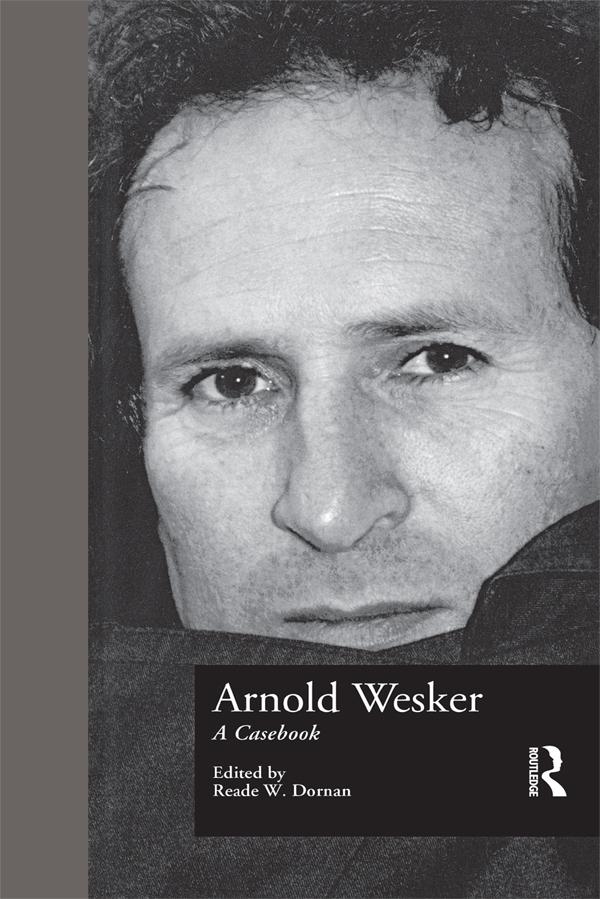
The only collection of essays on one of Britain's Angry Young Men, this book contains discussions of most of Wesker's published plays with an emphasis on the more recent works. Essays reevaluate the plays that made Wesker a household name in Britain (the Trilogy, TheKitchen , and Chips with Everything). Clive Barker, co-director of Centre 42, gives a fresh account of that movement, and playwright Paul Levitt provides a previously unrecorded history of Caritas, Blood Libel,and Shylock. A personal profile of Wesker by novelist Margaret Drabble is reprinted from an earlier article. Original essays cover the theory and practice of theatre-Wesker's in-text stage directions, British television's adaptation of his plays, and an actor's and a director's perspectives on working with the playwright.
Major international Weskerian critics are assembled here: Klaus Peter Mÿller and Heiner Zimmermann from Germany; Rossana Bonadei, Angela Locatelli, and Alessandra Marzola from Italy; Keith Gore, Glenda Leeming, Martin Priestman, Jeremy Ridgman, Margaret Rose, and Robert Wilcher from Great Britain; Menakshi Ponnuswami from India; Robert Gross, Kimball King, and Robert Skloot from the United States. These essays take a wide range of critical approaches from an exploration of gender, to semiotics, biography, and the New Historicism. This is the most comprehensive collection of criticism on Arnold Wesker to date. Every major Weskerian scholar writing in English has contributed a piece to this casebook. Originating in Germany, Italy, Great Britain, India, and the United States, their essays create an international cultural context for Wesker's plays.
They also position his work among his contemporaries, in his historical era, and in the political and theatrical environment that defines his world. Furthermore, they form a biographical profile of Wesker, often giving us firsthand accounts of turning points in his career. Finally, some essays evaluate and interpret the major plays, dissecting and scrutinizing the formal elements that make them distinct. Their critical approaches are varied in that they make liberal use of semiotics, Bakhtinian and communication theory, cultural studies, and traditional readings. Their contributions compose a multi-faceted view of Wesker's life and work setting out fresh arguments for all his plays.
Pay easily by card, Klarna, Apple Pay or Google Pay. Not happy? You always have a 14-day money-back guarantee. Read more in our terms. If you have any questions, email us at hello@memmo.org.
Memmo makes studying easier – wherever you are in the world. We bring your course books and smart study tools together in one place: summaries, quizzes, podcasts and flashcards. Plus Ted, your study buddy who answers anything you wonder. Over 75,000 students already study here – built to help you learn faster and stress less.