
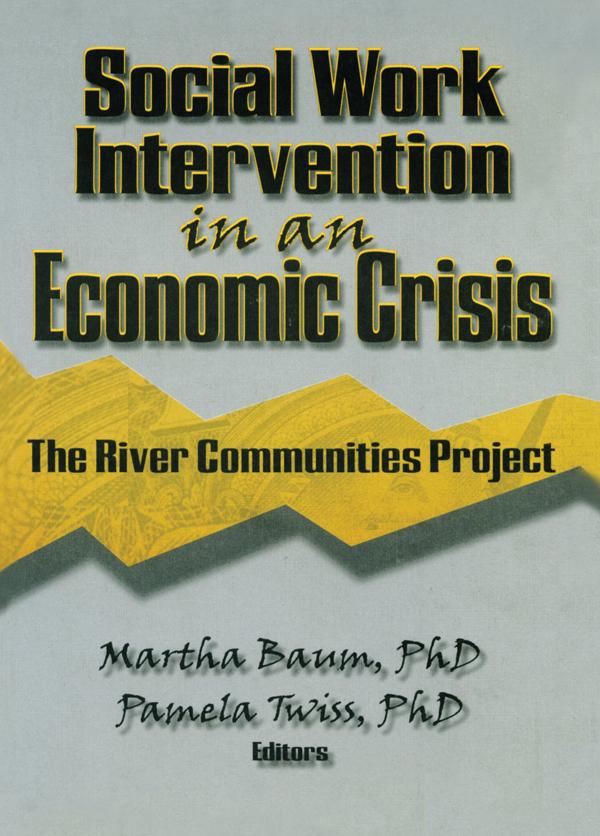
With the collapse of the steel industry in the 1980s, economic devastation hit the Pittsburgh, Pennsylvania, region. Social Work Intervention in an Economic Crisis strives to deepen understanding of the impact of the economic tragedy in the Pittsburgh region and to present social workers’efforts to enhance recovery. This case study serves as a model for social workers, human service educators and agency personnel, public health professionals, community organizers, policymakers, economic strategists, and researchers in social work, public health, sociology, anthropology, and political science to design and implement human service interventions for similar communities using techniques of action research, community organization, and demonstration projects.Social Work Intervention in an Economic Crisis shows readers relatively simple and highly effective ways of assessing the social-economic situation in their given geographical area. This allows professionals to be in touch with their surrounding communities and estimate the clientele to be served, their particular needs, and their abilities to access services. Chapters in Social Work Intervention in an Economic Crisis describe the responses of local institutions; the roles of informal and formal support networks; and the economic devastation inflicted upon individuals, households, and whole communities. To this end, Hide Yamatani, Lambert Maguire, Robin K. Rogers, and Mary Lou O’Kennedy take the socioeconomic “pulse” of six communities, launching a longitudinal monitoring effort that can be replicated elsewhere for long-range planning and intervention; Martha Baum, Barbara K. Shore, and Kathy Fleissner address the special problems women face; Mary Page and Myrna Silverman focus upon the elderly and their families; Phyllis D. Coontz, Judith A. Martin, and Edward W. Sites look at fathers facing altered childrearing; and Lambert Maguire and Hide Yamatani discuss youth facing altered economic opportunities. With this knowledge in hand, readers acquire skills for:
- using action research to assess how economic tragedy affects people’s lives
- mobilizing appropriate actors to engage in intervention
- learning from community groups and leaders about their concerns to work with them rather than for them
- recognizing the properties of community cohesion versus fragmentation as they affect efforts of renewal
- identifying individuals and families suffering most under economic devastation
- realizing the limits of micro-level intervention
- generating macro policies at the state and federal levels
- disseminating findings from action research and intervention/demonstration efforts Finally, Social Work Intervention in an Economic Crisis offers proposals for new societal mechanisms that might reduce the impact of future recessions. The findings and policy proposals set forth in this book help households and institutions deal with the effects of economic change which continue to afflict many families and small communities in the 1990s.
Pay easily by card, Klarna, Apple Pay or Google Pay. Not happy? You always have a 14-day money-back guarantee. Read more in our terms. If you have any questions, email us at hello@memmo.org.
Memmo makes studying easier – wherever you are in the world. We bring your course books and smart study tools together in one place: summaries, quizzes, podcasts and flashcards. Plus Ted, your study buddy who answers anything you wonder. Over 50,000 students already study here – built to help you learn faster and stress less.