
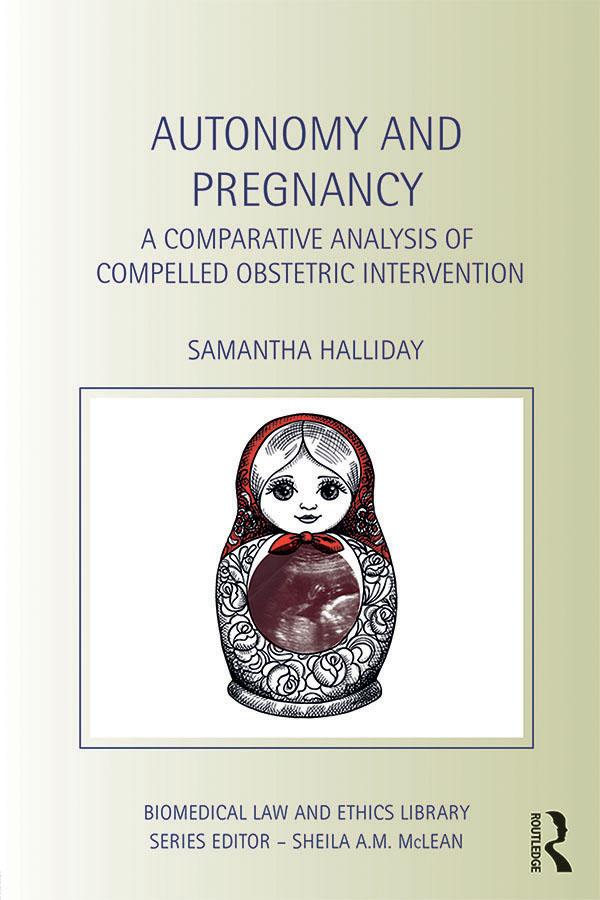
Technology has come to dominate the modern experience of pregnancy and childbirth, but instead of empowering pregnant women, technology has been used to identify the foetus as a second patient characterised as a distinct entity with its own needs and interests. Often, foetal and the woman’s interests will be aligned, though in legal and medical discourses the two ‘patients’ are frequently framed as antagonists with conflicting interests.
This book focuses upon the permissibility of encroachment on the pregnant woman’s autonomy in the interests of the foetus. Drawing on the law in England & Wales, the United States of America and Germany, Samantha Halliday focuses on the tension between a pregnant woman’s autonomy and medical actions taken to protect the foetus, addressing circumstances in which courts have declared medical treatment lawful in the face of the pregnant woman’s refusal of consent.
As a work which calls into question the understanding of autonomy in prenatal medical care, this book will be of great use and interest to students, researchers and practitioners in medical law, comparative law, bioethics, and human rights.
Pay easily by card, Klarna, Apple Pay or Google Pay. Not happy? You always have a 14-day money-back guarantee. Read more in our terms. If you have any questions, email us at hello@memmo.org.
Memmo makes studying easier – wherever you are in the world. We bring your course books and smart study tools together in one place: summaries, quizzes, podcasts and flashcards. Plus Ted, your study buddy who answers anything you wonder. Over 50,000 students already study here – built to help you learn faster and stress less.