
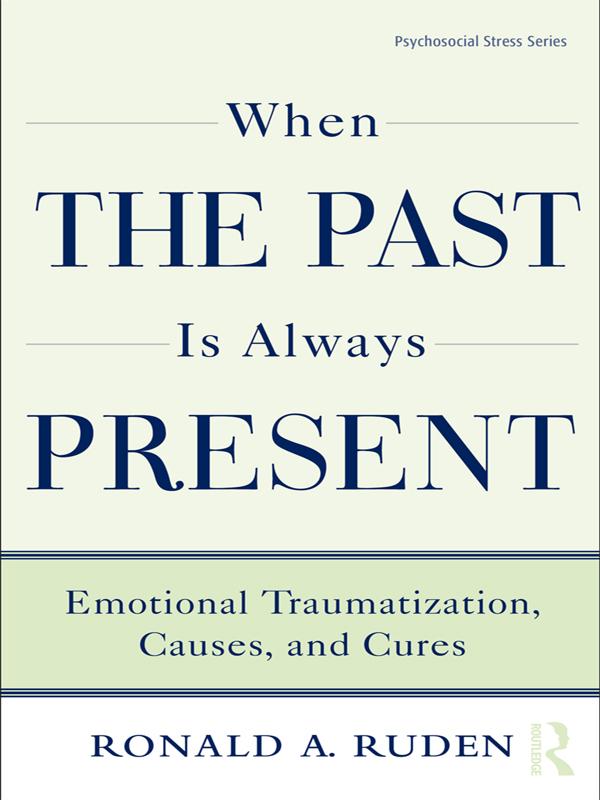
When the Past Is Always Present: Emotional Traumatization, Causes, and Cures introduces several new ideas about trauma and trauma treatment. The first of these is that another way to treat disorders arising from the mind/brain may be to use the senses. This idea, which is at the core of psychosensory therapy, forms what the author considers the "third pillar" of trauma treatment (the first and second pillars being psychotherapy and psychopharmacology). Psychosensory therapy postulates that sensory input—for example, touch—creates extrasensory activity that alters brain function and the way we respond to stimuli.
The second idea presented in this book is that traumatization is encoded in the amygdala only under special circumstances. Thus, by understanding what makes an individual resistant to traumatization we can offer a way of preventing it.
The third idea is that traumatization occurs because we cannot find a haven during the event. This is the cornerstone of havening, the particular form of psychosensory therapy described in the book. Using evolutionary biological principles and recently published neuroscientific studies, this book outlines in detail how havening touch de-links the emotional experience from a trauma, essentially making it just an ordinary memory. Once done, the event no longer causes distress.
Pay easily by card, Klarna, Apple Pay or Google Pay. Not happy? You always have a 14-day money-back guarantee. Read more in our terms. If you have any questions, email us at hello@memmo.org.
Memmo makes studying easier – wherever you are in the world. We bring your course books and smart study tools together in one place: summaries, quizzes, podcasts and flashcards. Plus Ted, your study buddy who answers anything you wonder. Over 50,000 students already study here – built to help you learn faster and stress less.