
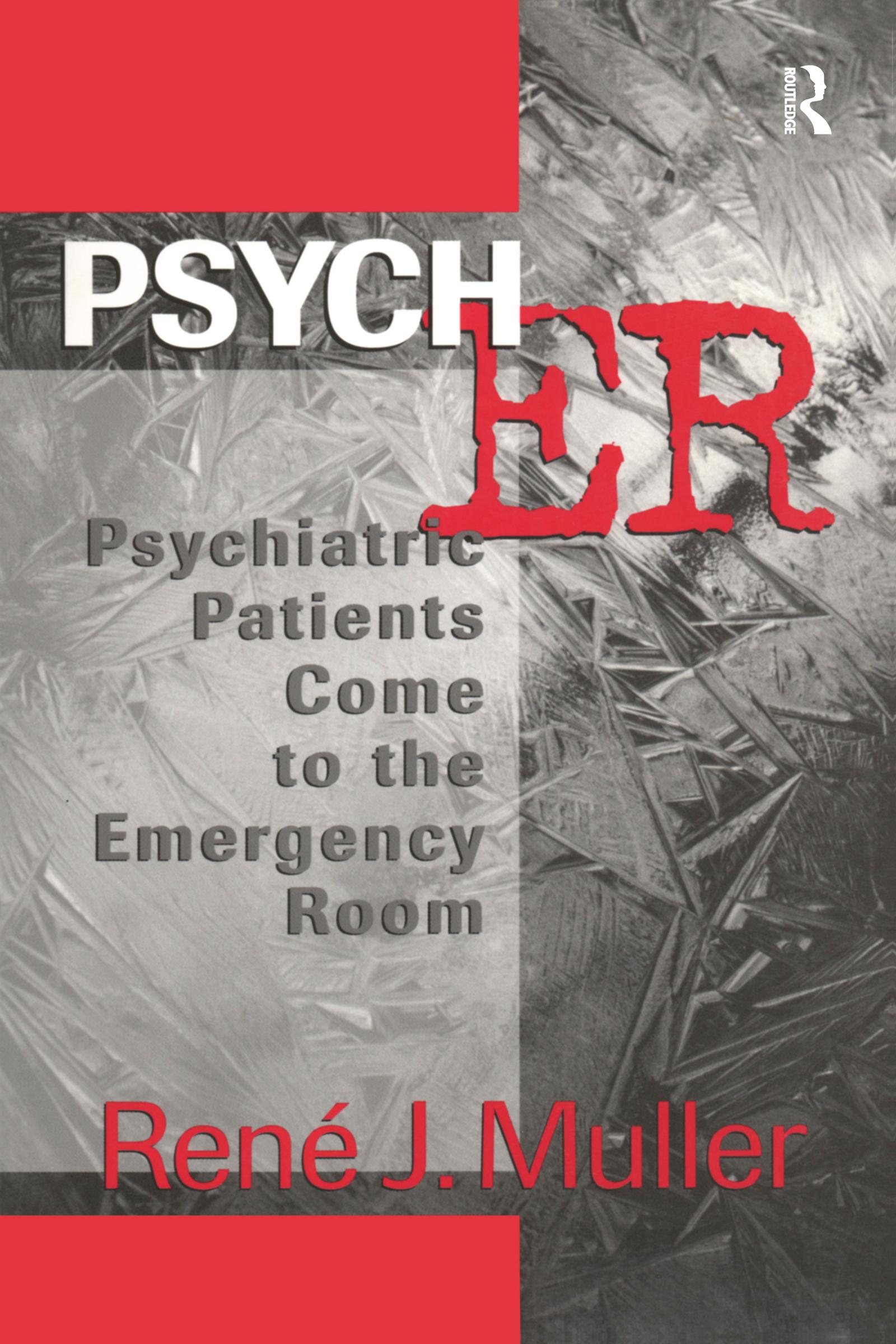
Drawing on the experience of evaluating over 2000 emergency room patients, René Muller explores the important role of psychiatry in emergency room medicine. He discusses some of his most challenging cases, showing how psychiatry comes to the aid of medicine in managing the crises - real, imagined, and contrived - that are the everyday fare of clinicians who work in the ER. We are introduced to a world in which lies are exposed, manipulations revealed, diagnoses made, medications adjusted, and even very brief psychotherapy attempted.
Muller begins with patient narratives rooted in the mental disorders most commonly encountered in the ER: Depression, panic disorder, drug dependence, bipolar depression, bipolar mania, schizophrenia, and Alzheimer's dementia. These stories pave the way for more puzzling ER cases, which Muller gathers into sections of "Veiled and Bizarre Stories" and "Stories with a Medical Component." He introduces us to the meanings of ER malingering and offers hard-won insights into managing "dumps" (when patients are dumped into the ER by families, police, doctors) and "stumbles" (when patients' bizarre behavior lands them in the ER).
The stories patients tell - and the questions these stories raise - drive Muller's text. A young man has seriously overdosed, but with what? Why has a successfully medicated schizophrenic suddenly begun hearing voices again? And what are we to make of a patient who is willing to risk death attempting to "drown" his hiccups by drinking up to 12 liters of fluid a day? For these and equally fascinating questions, Muller is a sure-handed guide, working his way through one ER challenge after another with psychiatric acumen and a balanced appreciation of the medical, custodial, socioeconomic, and legal dimensions of ER work. An intriguing account of the competing agendas that enter into the handling of emergencies, Psych ER is also a compilation of evocative patient stories about the subjective experience of being ill.
Pay easily by card, Klarna, Apple Pay or Google Pay. Not happy? You always have a 14-day money-back guarantee. Read more in our terms. If you have any questions, email us at hello@memmo.org.
Memmo makes studying easier – wherever you are in the world. We bring your course books and smart study tools together in one place: summaries, quizzes, podcasts and flashcards. Plus Ted, your study buddy who answers anything you wonder. Over 50,000 students already study here – built to help you learn faster and stress less.