
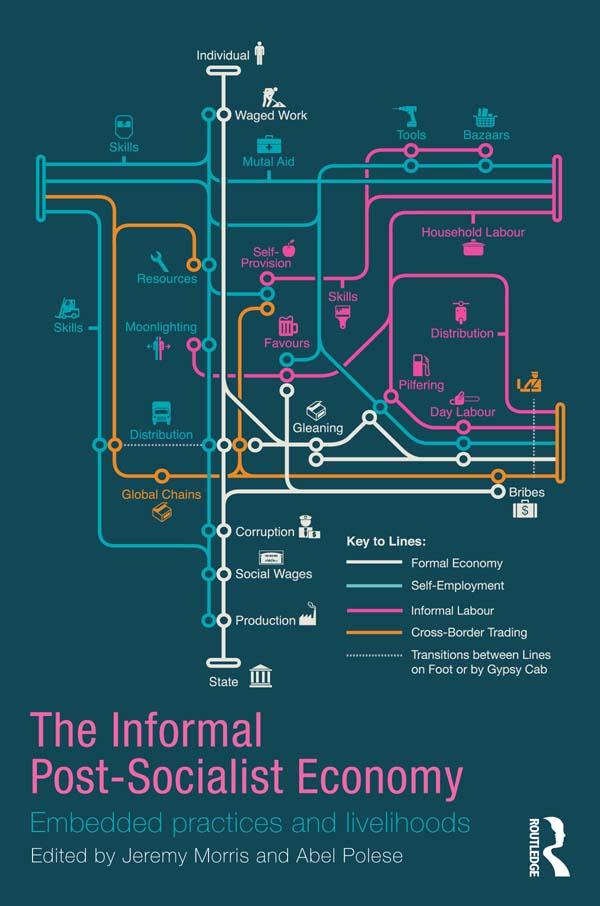
From smugglers to entrepreneurs, blue-collar workers and taxi drivers, this book deals with the multitude of characters engaged in informal economic practices in the former socialist regions. Going beyond a conception of informality as opposed to the formal sector, its authors demonstrate the fluid nature of informal transactions straddling the crossroads between illegal, illicit, socially acceptable and symbolically meaningful practices. Their argument is informed by a wide range of case studies, from Central Europe to the Baltics and Central Asia, each of which is constructed around a single informant. Each chapter narrates the story of a composite person or household that was carefully selected or constructed by an author with long-standing ethnographic research experience in the given field site.
Wide in geographical, empirical and theoretical scope, the book uses ethnographic narrative accounts of everyday life to make links between ‘ordinary’ meanings of informality. Challenging reductively economistic perspectives on cross-border trading, undeclared work and other informal activities, the authors illustrate the wide variety of interpretive meanings that people ascribe to such practices. Alongside ‘getting by’ and ‘getting ahead’ in recently marketised societies, these meanings relate to sociality, kinship-ties and solidarity, along with more surprising ‘political’ and moral reasonings.
Pay easily by card, Klarna, Apple Pay or Google Pay. Not happy? You always have a 14-day money-back guarantee. Read more in our terms. If you have any questions, email us at hello@memmo.org.
Memmo makes studying easier – wherever you are in the world. We bring your course books and smart study tools together in one place: summaries, quizzes, podcasts and flashcards. Plus Ted, your study buddy who answers anything you wonder. Over 50,000 students already study here – built to help you learn faster and stress less.