
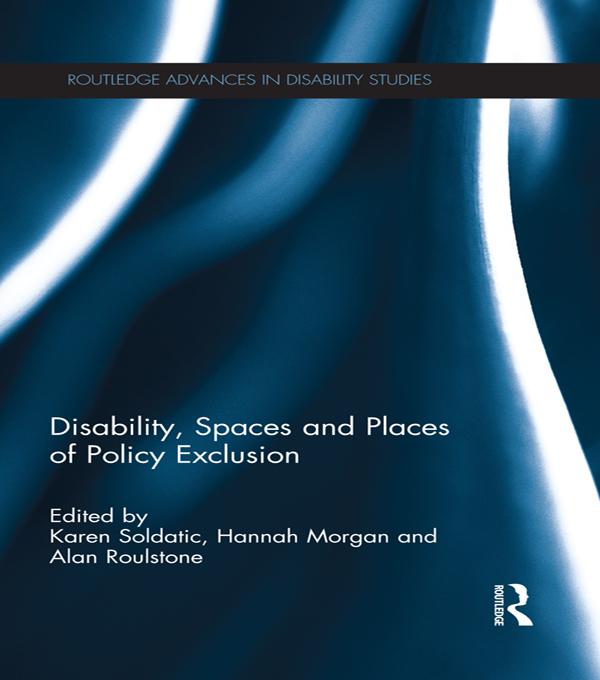
Geographies of disability have become a key research priority for many disability scholars and geographers. This edited collection, incorporating the work of leading international disability researchers, seeks to expand the current geographical frame operating within the realm of disability. Providing a critical and comprehensive examination of disability and spatial processes of exclusion and inclusion for disabled people, the book uniquely brings together insights from disability studies, spatial geographies and social policy with the purpose of exploring how spatial factors shape, limit or enhance policy towards, and the experiences of, disabled people.
Divided into two parts, the first section explores the key concepts to have emerged within the field of disability geographies, and their relationship to new policy regimes. New and emerging concepts within the field are critically explored for their significance in conceptually framing disability. The second section provides an in-depth examination of disabled people’s experience of changing landscapes within the onset of emerging disability policy regimes. It deals with how the various actors and stakeholders, such as governments, social care agencies, families and disabled people traverse these landscapes under the new conditions laid out by changing policy regimes. Crucially, the chapters examine the lived meaning of changing spatial relations for disabled people.
Grounded in recent empirical research, and with a global focus, each of the chapters reveal how social policy domains are challenged or undermined by the spatial realities faced by disabled people, and expands existing understandings of disability. In turn, the book supports readers to grasp future policy directions and processes that enable disabled people's choices, rights and participation. This important work will be invaluable reading for students and researchers involved in disability, geography and social policy.
Pay easily by card, Klarna, Apple Pay or Google Pay. Not happy? You always have a 14-day money-back guarantee. Read more in our terms. If you have any questions, email us at hello@memmo.org.
Memmo makes studying easier – wherever you are in the world. We bring your course books and smart study tools together in one place: summaries, quizzes, podcasts and flashcards. Plus Ted, your study buddy who answers anything you wonder. Over 50,000 students already study here – built to help you learn faster and stress less.