
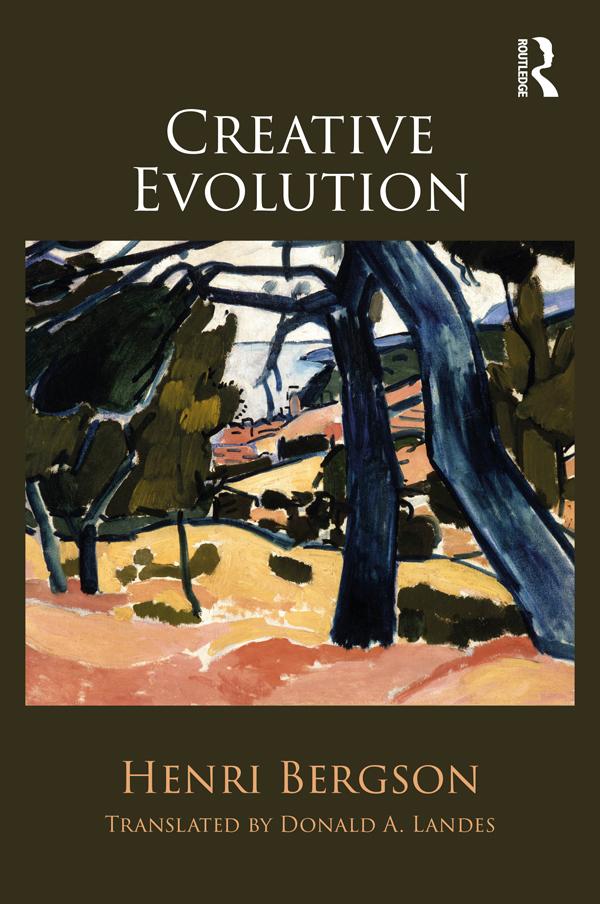
First published in French in 1907, Henri Bergson’s L’évolution créatrice is a scintillating and radical work by one of the great French philosophers of the nineteenth and twentieth centuries. This outstanding new translation, the first for over a hundred years, brings one of Bergson’s most important and ambitious works to a new generation of readers.
A sympathetic though critical reader of Darwin, Bergson argues in Creative Evolution against a mechanistic, reductionist view of evolution. For Bergson, all life emerges from a creative, shared impulse, which he famously terms élan vital and which passes like a current through different organisms and generations over time. Whilst this impulse remains as forms of life diverge and multiply, human life is characterized by a distinctive form of consciousness or intellect. Yet as Bergson brilliantly shows, the intellect’s fragmentary and action- oriented nature, which he likens to the cinematograph, means it alone cannot grasp nature’s creativity and invention over time. A major task of Creative Evolution is to reconcile these two elements. For Bergson, the answer famously lies in intuition, which brings instinct and intellect together and takes us “into the very interior of life.”
A work of great rigour and imaginative richness that contributed to Bergson winning the Nobel Prize for Literature in 1927, Creative Evolution played an important and controversial role in the trajectory of twentieth-century philosophy and continues to create significant discussion and debate. The philosopher and psychologist William James, who admired Bergson’s work, was writing an introduction to the first English translation of the book before his death in 1910.
This new translation includes a foreword by Elizabeth Grosz and a helpful translator’s introduction by Donald Landes. Also translated for the first time are additional notes, articles, reviews and letters on the reception of Creative Evolution in biology, mathematics, and theology. This edition includes fascinating commentaries by philosophers Maurice Merleau-Ponty, Georges Canguilhem, and Gilles Deleuze.
Pay easily by card, Klarna, Apple Pay or Google Pay. Not happy? You always have a 14-day money-back guarantee. Read more in our terms. If you have any questions, email us at hello@memmo.org.
Memmo makes studying easier – wherever you are in the world. We bring your course books and smart study tools together in one place: summaries, quizzes, podcasts and flashcards. Plus Ted, your study buddy who answers anything you wonder. Over 50,000 students already study here – built to help you learn faster and stress less.