
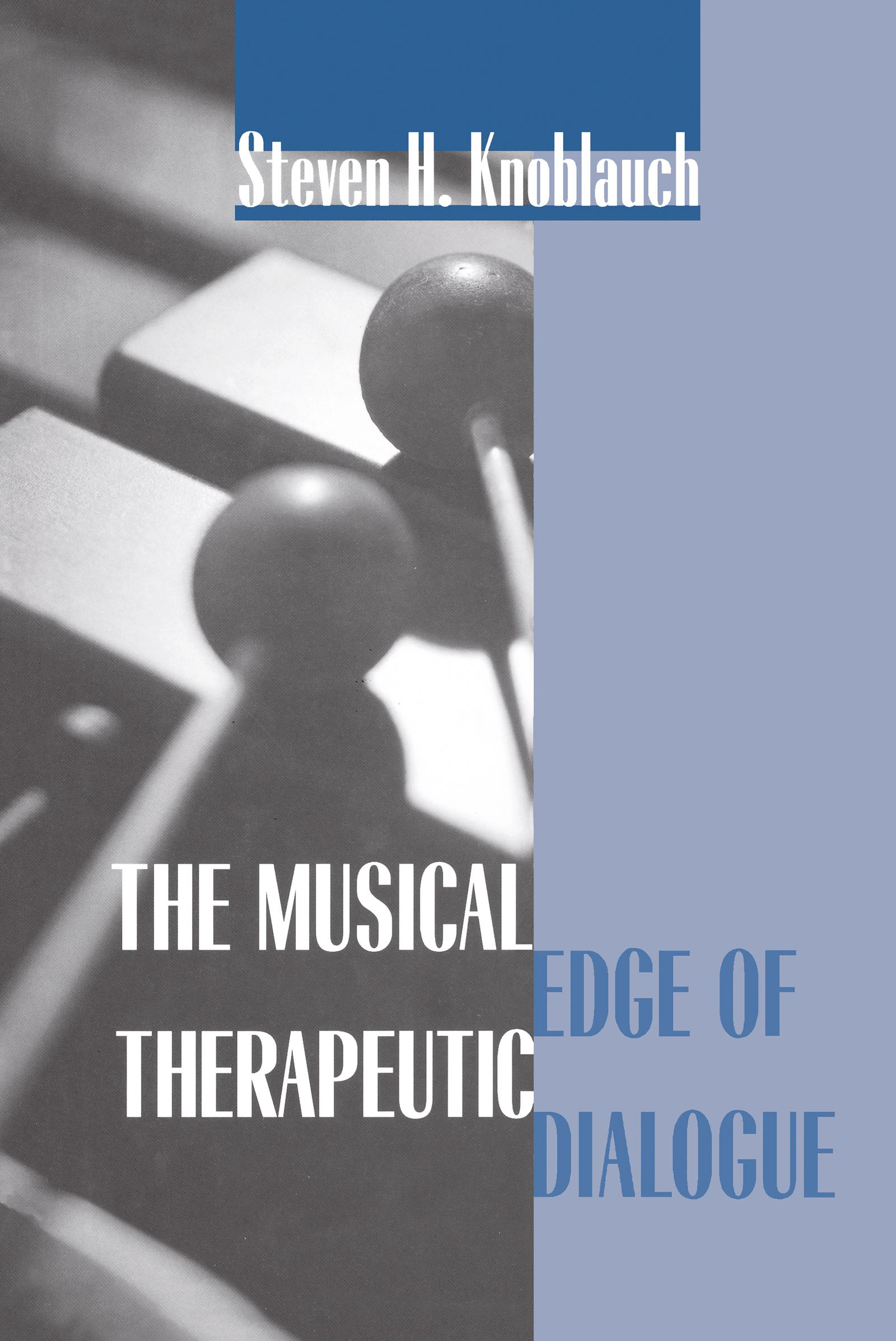
Such nuances and shifts in the music of a patient's voice have long been familiar to clinicians. Indeed, as Steven Knoblauch observes, the music of psychotherapy has been acknowledged across a variety of theoretical orientations, from Freudian to self-psychological to interpersonal and relational perspectives. In The Musical Edge of Therapeutic Dialogue, Knoblauch provides a model of "resonant minding" in which the musical elements of speech become a major source of information about unconscious communication and action. More specifically, resonant minding, by distinguishing between discrete and continuous levels of communication, between the verbal and the musical, offers a way of accessing and affecting levels of unconscious interactive process by attending to the musical edge of dialogue -- provided only that we can hear it.
Drawing on detailed clinical vignettes, he explores shifts in embodied dimensions of musical expression including rhythm, tone, pauses and accents across a sequence of patient-therapist interactions in order to show how the dyadic logic of mutual improvisation operates at the periphery to guide the continuous flow of unconscious communication and mutual regulation. In so doing, Knoblauch provides a vivid sense of how the shifting movement of the patient's "solo performance" can be facilitated and enriched by the creative "accompaniment" of the therapist.
Ultimately, Knoblauch argues, the music of therapy is not only another road to the unconscious, but one uniquely able to convey emergent meanings in a variety of domains, from conflicting cultural identifications to the experience of the body to the emergence of desire. His vision of mutual immersion in a shared "performance" aimed at fostering growth coalesces into a major contribution - at once evocative and clinically consequential - to the current movement to grasp nonverbal behavior and processes of mutual regulation as they enter into all effective psychotherapy.
Pay easily by card, Klarna, Apple Pay or Google Pay. Not happy? You always have a 14-day money-back guarantee. Read more in our terms. If you have any questions, email us at hello@memmo.org.
Memmo makes studying easier – wherever you are in the world. We bring your course books and smart study tools together in one place: summaries, quizzes, podcasts and flashcards. Plus Ted, your study buddy who answers anything you wonder. Over 50,000 students already study here – built to help you learn faster and stress less.