
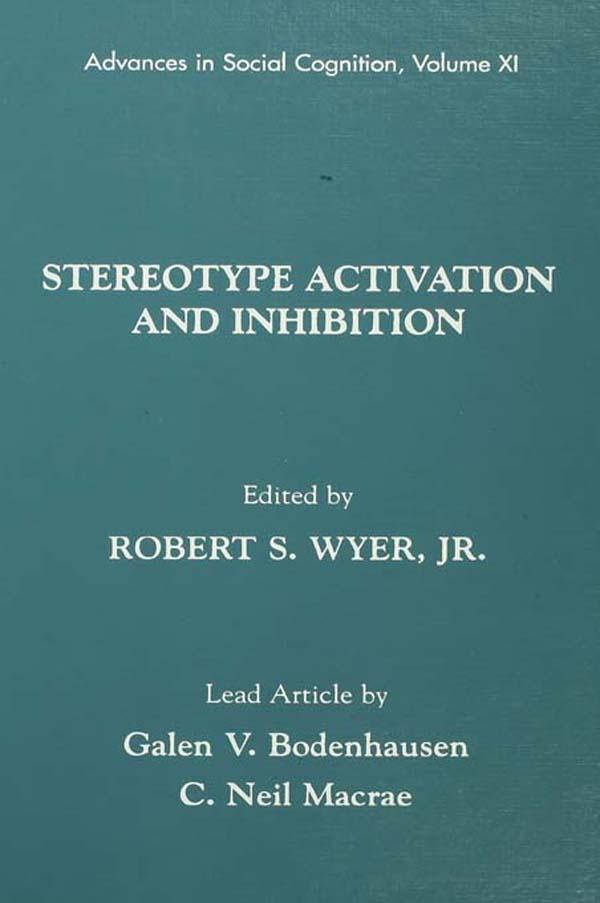
The use of social sterotypes as a basis for judgments and behavioral decisions has been a major focus of social psychological theory and research since the field began. Although motivational and cognitive influences on stereotyping have been considered, these two general types of influence have rarely been conceptually integrated within a common theoretical framework. Nevertheless, almost every area of theoretical and empirical concern in social cognition--areas such as the interpretation of new information, memory and retrieval processes, impression formation, the use of heuristic vs. analytic processing strategies, the role of affect in information processing, and self-esteem maintenance--has implications for this important social phenomenon.
This volume's target article brings together the research of Galen Bodenhausen, Neil Macrae, and others within a theoretical framework that accounts for the processes that underlie both the activation of stereotypes and attempts to suppress their influence. They consider several stages of processing, including:
*the categorization of a stimulus person;
*the influence of this categorization on the interpretation of information about the stimulus person; and
*the social judgments and behavioral decisions that are ultimately made.
The stereotype activation and suppression mechanisms that the target article authors consider operate at all of these stages. Their conceptualization provides a framework within which the interrelatedness of processing at these stages can be understood.
The 11th in the series, this volume includes companion articles that help to refine and extend the target article's conceptualization and make important theoretical contributions in their own right. They are written by prominent researchers in cognitive and social psychology, many of whom are active contributors to research and theory on stereotyping. They address the following topics:
* the role of power and control in stereotype-based information processing;
* the influence of prejudice;
* self-regulatory processes;
* social categorization;
* the correction processes that result from perceptions of bias; and
* the conceptualization of stereotypes themselves.
Pay easily by card, Klarna, Apple Pay or Google Pay. Not happy? You always have a 14-day money-back guarantee. Read more in our terms. If you have any questions, email us at hello@memmo.org.
Memmo makes studying easier – wherever you are in the world. We bring your course books and smart study tools together in one place: summaries, quizzes, podcasts and flashcards. Plus Ted, your study buddy who answers anything you wonder. Over 50,000 students already study here – built to help you learn faster and stress less.