
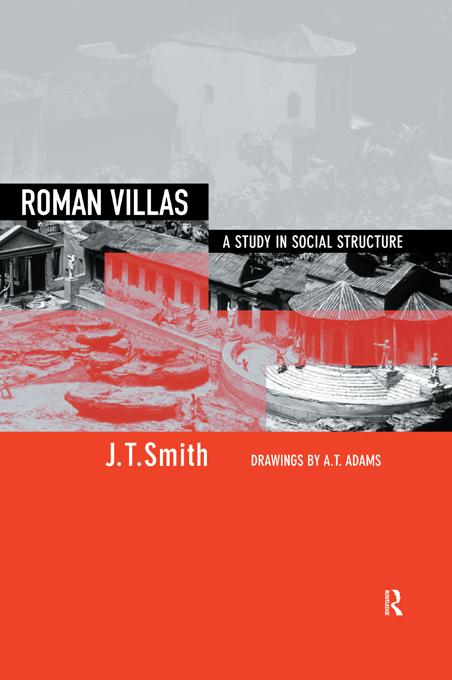
Roman Villas explores the social structures of the Roman world by analysing the plans of buildings of all sizes from slightly Romanized farms to palaces. The ways in which the rooms are grouped together; how they intercommunicate; and the ways in which individual rooms and the house are approached, reveal various social patterns, which question traditional ideas about the Roman family and household. J. T. Smith argues that virtually all houses were occupied by groups of varying composition, challenging the received wisdom that they were single family houses whose size reflected only the owner's wealth and number of servants.
Roman Villas provides a meticulously documented and scholarly examination of the relationship between the living quarters of the Roman and their social and economic development which introduces a new area in Roman studies and a corpus of material for further analysis. The inclusion of almost 500 ground plans, drawn to a uniform scale, allows the reader to compare the similarities and differences between house structure as well as effectively illustrating the arguments.
Pay easily by card, Klarna, Apple Pay or Google Pay. Not happy? You always have a 14-day money-back guarantee. Read more in our terms. If you have any questions, email us at hello@memmo.org.
Memmo makes studying easier – wherever you are in the world. We bring your course books and smart study tools together in one place: summaries, quizzes, podcasts and flashcards. Plus Ted, your study buddy who answers anything you wonder. Over 75,000 students already study here – built to help you learn faster and stress less.