
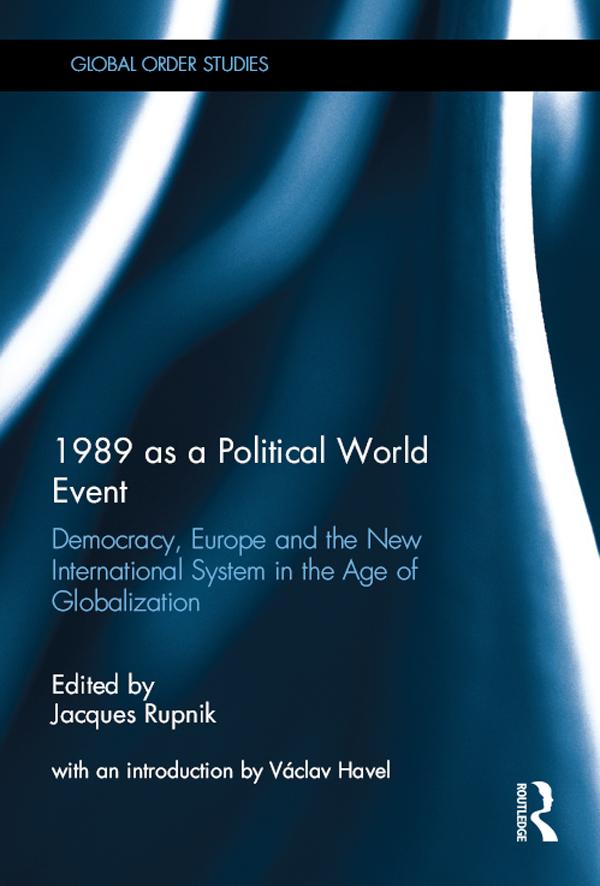
This book is not about the events of 1989, but about 1989 as a world event. Starting with the fall of the Berlin Wall and the collapse of the Soviet bloc it examines the historical significance and the world brought about by 1989.
When the Cold War ended in Europe it ushered in a world in which the international agenda is set outside Europe, in America or Asia. The book critically examines and moves beyond some of the conveniently simple paradigms proposed in the nineties, by leading political scientists such as Fukuyama and Huntington, to show how the events of 1989 meant different things to different parties. This was an anti-utopian revolution, a symbol of the possibility of non-violent transitions to democracy, which raised the hopes of world-wide democratic changes. Contributors show how 1989 can be seen as the founding moment of a globalized world, but equal attention should be given to the dispersion of its meanings and the exhaustion of some of its main trends associated with the post-1989 era. Europe was reunited, yet it is in crisis. Twenty years on, global markets have brought about a global financial crisis. The fall of the Berlin Wall was celebrated as the advent of free movement in a world without borders. Now however, we can see that new borders, walls, fences have since been built.
With an introductory essay by Vaclav Havel, 1989 as a Political World Event will be of interest to scholars of European Politics and International Relations.
Pay easily by card, Klarna, Apple Pay or Google Pay. Not happy? You always have a 14-day money-back guarantee. Read more in our terms. If you have any questions, email us at hello@memmo.org.
Memmo makes studying easier – wherever you are in the world. We bring your course books and smart study tools together in one place: summaries, quizzes, podcasts and flashcards. Plus Ted, your study buddy who answers anything you wonder. Over 50,000 students already study here – built to help you learn faster and stress less.