
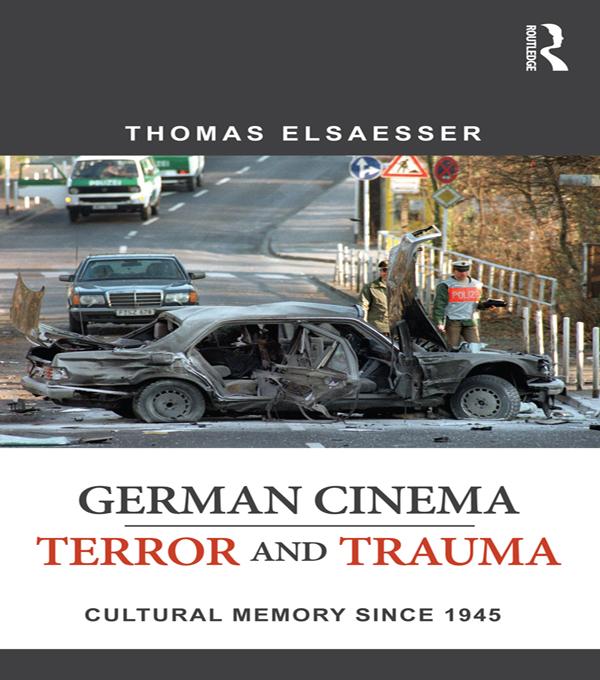
In German Cinema – Terror and Trauma Since 1945, Thomas Elsaesser reevaluates the meaning of the Holocaust for postwar German films and culture, while offering a reconsideration of trauma theory today. Elsaesser argues that Germany's attempts at "mastering the past" can be seen as both a failure and an achievement, making it appropriate to speak of an ongoing 'guilt management' that includes not only Germany, but Europe as a whole. In a series of case studies, which consider the work of Konrad Wolf, Alexander Kluge, Rainer Werner Fassbinder, Herbert Achterbusch and Harun Farocki, as well as films made in the new century, Elsaesser tracks the different ways the Holocaust is present in German cinema from the 1950s onwards, even when it is absent, or referenced in oblique and hyperbolic ways. Its most emphatically "absent presence" might turn out to be the compulsive afterlife of the Red Army Faction, whose acts of terror in the 1970s were a response to—as well as a reminder of—Nazism’s hold on the national imaginary. Since the end of the Cold War and 9/11, the terms of the debate around terror and trauma have shifted also in Germany, where generational memory now distributes the roles of historical agency and accountability differently. Against the background of universalized victimhood, a cinema of commemoration has, if anything, confirmed the violence that the past continues to exert on the present, in the form of missed encounters, retroactive incidents, unintended slippages and uncanny parallels, which Elsaesser—reviving the full meaning of Freud’s Fehlleistung—calls the parapractic performativity of cultural memory.
Pay easily by card, Klarna, Apple Pay or Google Pay. Not happy? You always have a 14-day money-back guarantee. Read more in our terms. If you have any questions, email us at hello@memmo.org.
Memmo makes studying easier – wherever you are in the world. We bring your course books and smart study tools together in one place: summaries, quizzes, podcasts and flashcards. Plus Ted, your study buddy who answers anything you wonder. Over 50,000 students already study here – built to help you learn faster and stress less.