
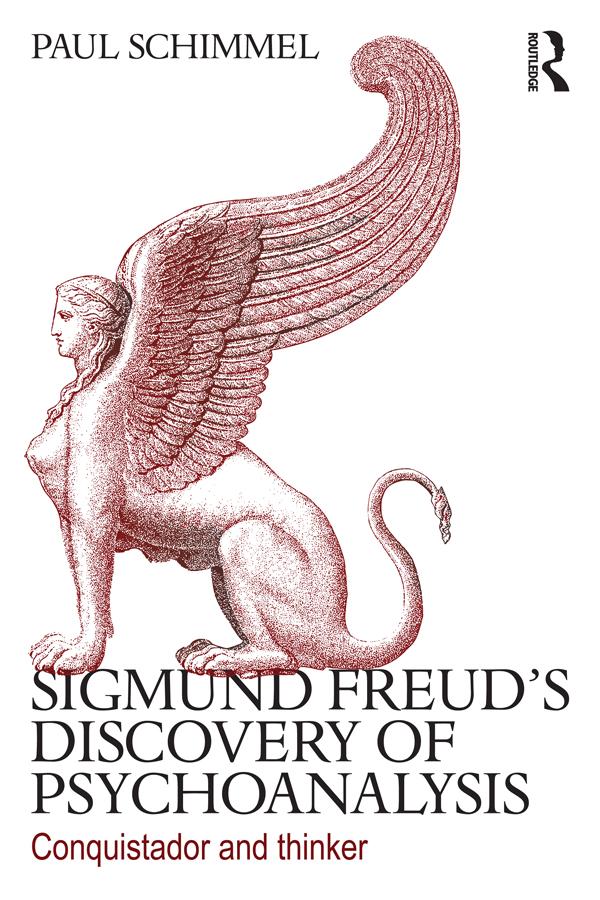
Sigmund Freud’s discovery of psychoanalysis explores links between Freud’s development of his thinking and theory and his personal emotional journey. It follows his early career as a medical student, researcher and neurologist, and then as a psychotherapist, to focus on the critical period 1895-1900. During these years Freud submitted himself to the process that has become known as his ‘self-analysis’, and developed the core of his psychoanalytic theory. Drawing on Freud’s letters to his friend and confidant Wilhelm Fliess, and on selected psychoanalytic writings in particular his ‘dream of Irma’s injection’, Paul Schimmel formulates psychoanalytic dimensions to the biographical ‘facts’ of Freud’s life.
In 1900 Freud wrote that he was ‘not a thinker’ but ‘a conquistador’. In reality he was both, and was engaged in a lifelong emotional struggle to bring these contradictory sides of his personality into relationship. His psychoanalytic discoveries are conceptualized in the context of his need to achieve integration within his psyche, and in particular to forge a more creative collaboration between ‘conquistador’ and ‘thinker’.
Sigmund Freud’s discovery of psychoanalysis will be of interest to psychoanalysts, psychoanalytic psychotherapists, academics and teachers of psychoanalysis, and to all serious students of the mind.
Pay easily by card, Klarna, Apple Pay or Google Pay. Not happy? You always have a 14-day money-back guarantee. Read more in our terms. If you have any questions, email us at hello@memmo.org.
Memmo makes studying easier – wherever you are in the world. We bring your course books and smart study tools together in one place: summaries, quizzes, podcasts and flashcards. Plus Ted, your study buddy who answers anything you wonder. Over 50,000 students already study here – built to help you learn faster and stress less.