
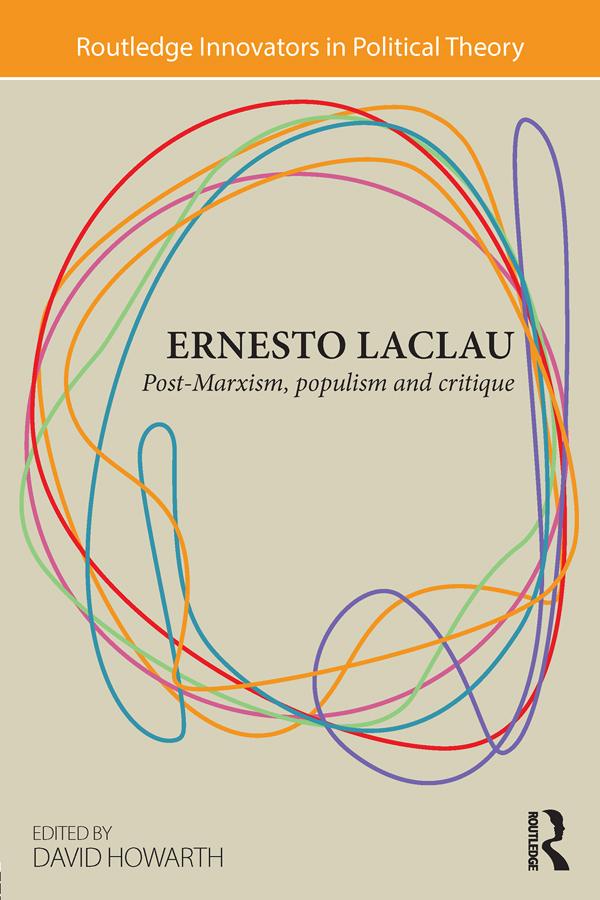
Ernesto Laclau has blazed a unique trail in political theory and philosophy since the early 1970s. In so doing, he has articulated a range of philosophical and theoretical currents into a coherent alternative to mainstream models and practices of conducting social and political science. The editors have focused on work in three key areas:
Post-Marxist Political Theory: Discourse, Hegemony, Signification
Laclau has developed an original conception of post-Marxist political theory that is grounded on a materialist theory of discourse. The latter is constructed from a range of theoretical and philosophical sources, including poststructuralism, psychoanalysis, linguistic theory and post-analytical philosophy. The centerpiece of this approach is the category of hegemony, which develops Antonio Gramsci’s seminal contribution to Marxist theory, and is in turn connected to a web of related concepts, including articulation, dislocation, the logics of equivalence and difference, political identification, myth and social imaginary. These ideas have informed a number of empirical and theoretical studies associated with the Essex School of Discourse Theory.
Analyzing Populism
A central concern of Laclau’s writings has been the question of populism, both in Latin America where hebegan his interrogation of the phenomenon (especially the experience of Peronism), and then in his engagement with the "new social movements" and socialist strategy more generally. The concept of populism becomes a general way of exploring the "primacy of politics" in society.
Critical Engagements
Laclau is first and foremost an engaged intellectual who has consistently sought to theorize contemporary events and reality, and to debate with the leading intellectual figures of the day, with respect to questions of political principle and strategy. His recent debates with Judith Butler and Slavoj Žižek in Contingency, Hegemony, Universality: Contemporary Dialogues on the Left, published in 2011 (London: Verso), exemplify this critical ethos. He continues to elaborate his approach by challenging and articulating related approaches, and by situating his work in connection to the democratic Left.
Pay easily by card, Klarna, Apple Pay or Google Pay. Not happy? You always have a 14-day money-back guarantee. Read more in our terms. If you have any questions, email us at hello@memmo.org.
Memmo makes studying easier – wherever you are in the world. We bring your course books and smart study tools together in one place: summaries, quizzes, podcasts and flashcards. Plus Ted, your study buddy who answers anything you wonder. Over 50,000 students already study here – built to help you learn faster and stress less.