
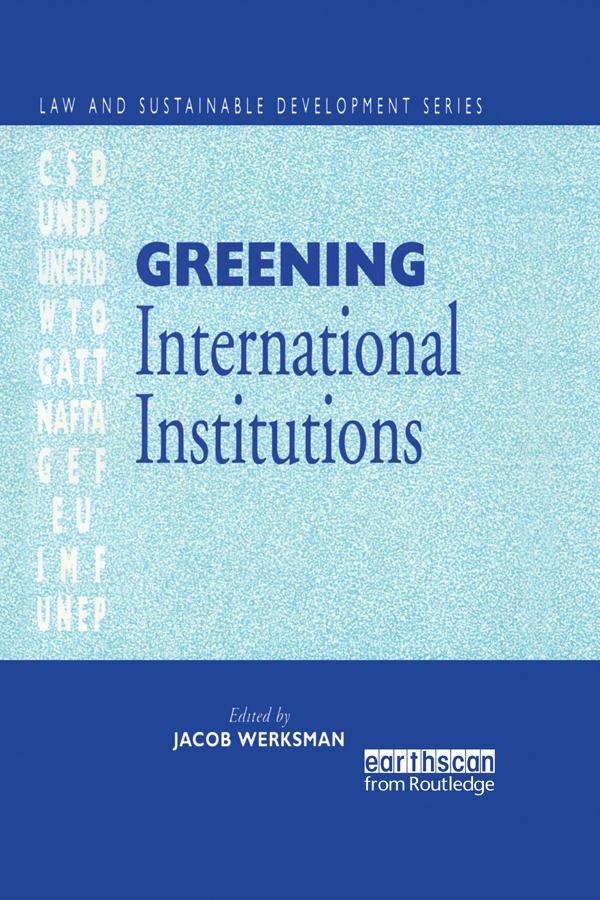
Environmentally sustainable development has become one of the world's most urgent priorities. But countries cannot achieve it alone: it depends on international coordination and action. Greening International Institutions, the latest in a series of highly-acclaimed publications devoted to environmental and developmental law, assesses how far and how successfully intergovernmental organizations have responded to the challenge.
The organizations analyzed include: the UN General Assembly, the new Commission for Sustainable Development, UNEP, UNDP and UNCTAD, WTO, GATT, NAFTA, the Bretton Woods institutions and several regional bodies, as well as treaty bodies and the mechanisms for avoiding and settling disputes. For each, the contributors provide an accessible overview of the organization's mandate and structure, examine substantive policy initiatives and assess the need and scope for procedural and institutional reform. Drawing together a collection of essays by lawyers and researchers from various backgrounds, Greening International Institutions is stimulating reading for students and policy-makers, as well as anyone concerned with the development of international institutions.
Jacob Werksman is an attorney, a Programme Director at FIELD, and Visiting Lecturer in International Economic Law at the University of London.
Greening International Institutions is the fifth volume in the International Law and Sustainable Development series, co-developed with FIELD. The series aims to address and define the major legal issues associated with sustainable development and to contribute to the progressive development of international law. Other titles in the series are: Greening International Law, Interpreting the Precautionary Principle, Property Rights in the Defence of Nature and Improving Compliance with International Environmental Law.
'A legal parallel to the Blueprint series - welcome, timely and provocative'
David Pearce
Originally published in 1996
Pay easily by card, Klarna, Apple Pay or Google Pay. Not happy? You always have a 14-day money-back guarantee. Read more in our terms. If you have any questions, email us at hello@memmo.org.
Memmo makes studying easier – wherever you are in the world. We bring your course books and smart study tools together in one place: summaries, quizzes, podcasts and flashcards. Plus Ted, your study buddy who answers anything you wonder. Over 50,000 students already study here – built to help you learn faster and stress less.