
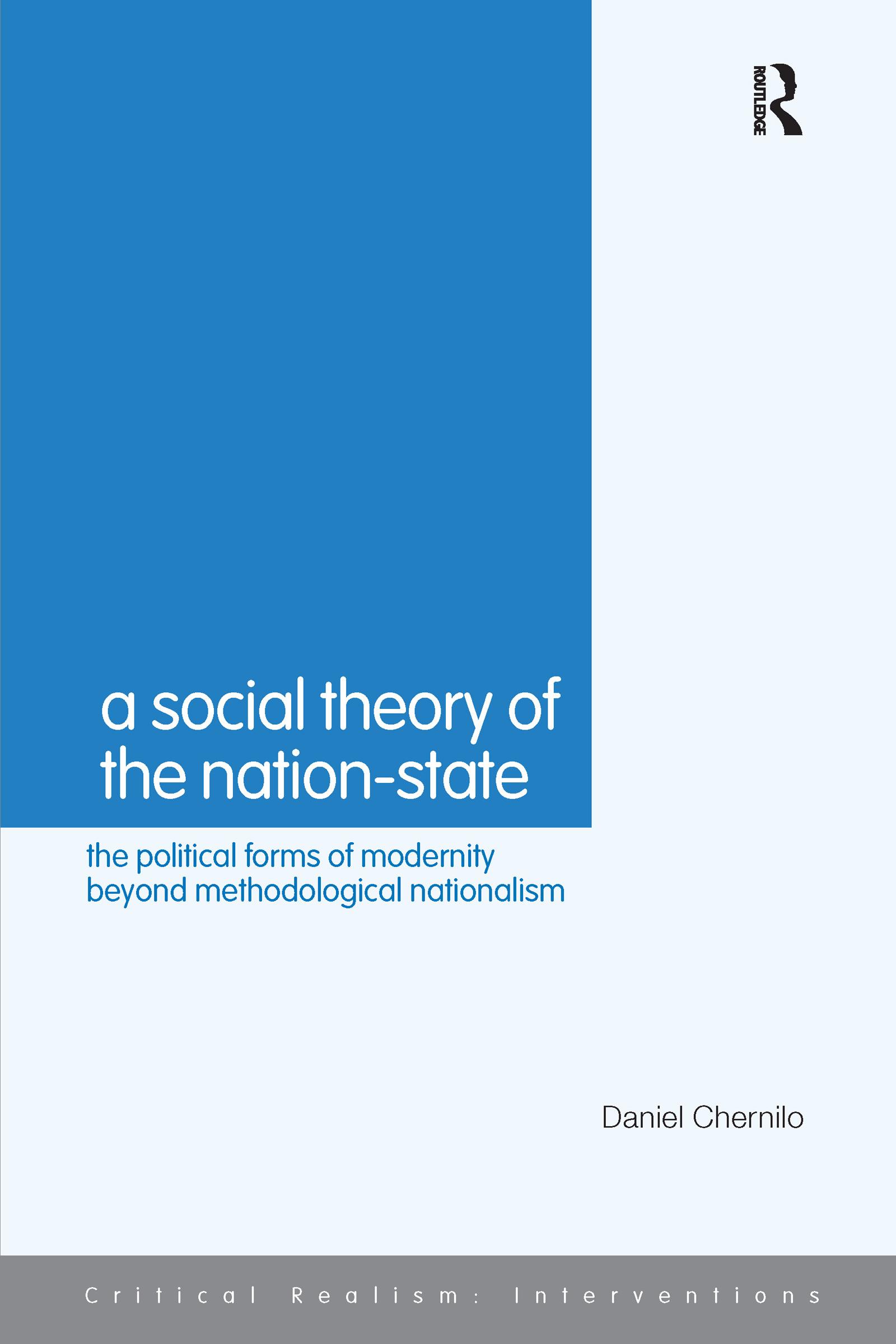
A Social Theory of the Nation-State: the political forms of modernity beyond methodological nationalism, construes a novel and original social theory of the nation-state. It rejects nationalistic ways of thinking that take the nation-state for granted as much as globalist orthodoxy that speaks of its current and definitive decline.
Its main aim is therefore to provide a renovated account of the nation-state’s historical development and recent global challenges via an analysis of the writings of key social theorists. This reconstruction of the history of the nation-state into three periods:
- classical (K. Marx, M. Weber, E. Durkheim)
- modernist (T. Parsons, R. Aron, R. Bendix, B. Moore)
- contemporary (M. Mann, E. Hobsbawm, U. Beck, M. Castells, N. Luhmann, J. Habermas)
For each phase, it introduces social theory’s key views about the nation-state, its past, present and future. In so doing this book rejects methodological nationalism, the claim that the nation-state is the necessary representation of the modern society, because it misrepresents the nation-state’s own problematic trajectory in modernity. And methodological nationalism is also rejected because it is unable to capture the richness of social theory’s intellectual canon. Instead, via a strong conception of society and a subtler notion of the nation-state, A Social Theory of the Nation-State tries to account for the ‘opacity of the nation-state in modernity’.
Pay easily by card, Klarna, Apple Pay or Google Pay. Not happy? You always have a 14-day money-back guarantee. Read more in our terms. If you have any questions, email us at hello@memmo.org.
Memmo makes studying easier – wherever you are in the world. We bring your course books and smart study tools together in one place: summaries, quizzes, podcasts and flashcards. Plus Ted, your study buddy who answers anything you wonder. Over 50,000 students already study here – built to help you learn faster and stress less.