
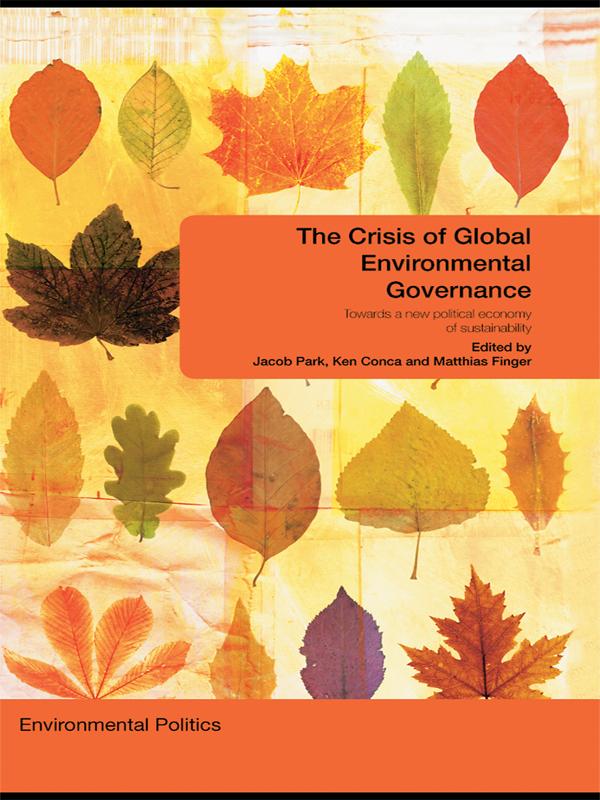
More than twenty years after the Bruntland Commission report, Our Common Future, we have yet to secure the basis for a serious approach to global environmental governance. The failed 2002 World Summit on Sustainable Development showed the need for a new approach to globalization and sustainability.
Taking a critical perspective, rooted in political economy, regulation theory, and post-sovereign international relations, this book explores questions concerning the governance of environmental sustainability in a globalizing economy. With contributions from leading international scholars, the book offers a comprehensive framework on globalization, governance, and sustainability, and examines institutional mechanisms and arrangements to achieve sustainable environmental governance. It:
- considers current failures in the framework of global environmental governance
- addresses the problematic relationship between sustainability and globalization
- explores controversies of development and environment that have led to new processes of institution building
- examines the marketization of environmental policy-making; stakeholder politics and environmental policy-making; socio-economic justice; the political origins of sustainable consumption; the role of transnational actors; and processes of multi-level global governance.
This book will be of interest to students and researchers of political science, international studies, political economy and environmental studies.
Pay easily by card, Klarna, Apple Pay or Google Pay. Not happy? You always have a 14-day money-back guarantee. Read more in our terms. If you have any questions, email us at hello@memmo.org.
Memmo makes studying easier – wherever you are in the world. We bring your course books and smart study tools together in one place: summaries, quizzes, podcasts and flashcards. Plus Ted, your study buddy who answers anything you wonder. Over 50,000 students already study here – built to help you learn faster and stress less.