
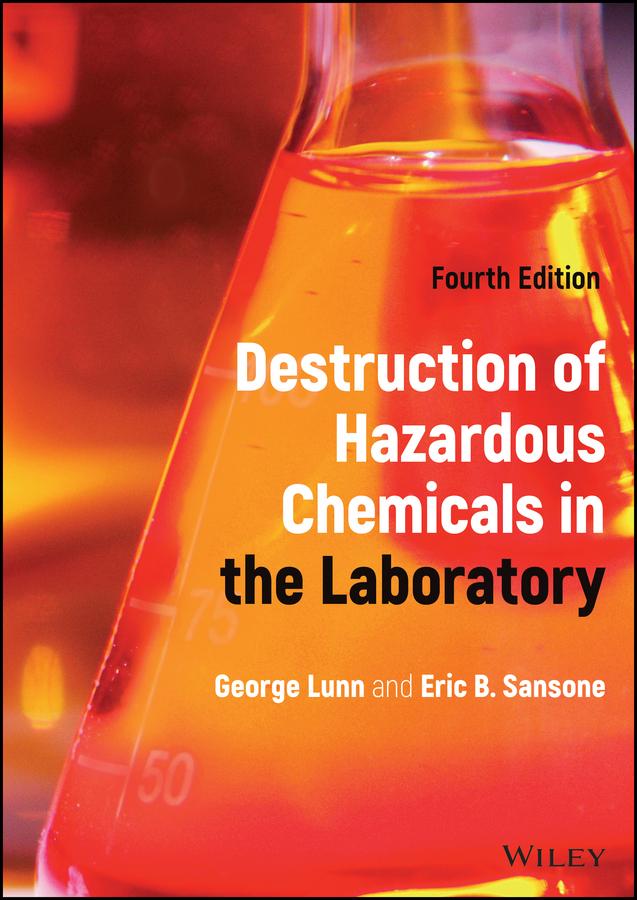
Single volume reference providing procedural information for the destruction of a wide variety of hazardous chemicals
Destruction of Hazardous Chemicals in the Laboratory is a practical reference that describes procedures for the destruction of a comprehensive list of hazardous chemicals and provides general methods for the destruction of hazardous chemicals in the laboratory without the need for exotic reagents and equipment.
Unlike most other sources on this subject, detailed reaction parameters are provided to readers. These details will help the reader decide if a procedure will be appropriate. To further aid in reader comprehension, numerous tables throughout the book allow for ready comparison of procedures.
Destruction of Hazardous Chemicals in the Laboratory also describes the critical aspects of various protocols (e.g., UV lamp type and rate of ozone flow).
The updated fourth edition Includes an updated survey of the literature from 2012-2021 and features data mined from 1,500 papers. It also describes recent examples of methods that are generally applicable to organic compounds and greatly expands the section on methods for the destruction of pharmaceuticals in the laboratory.
In this book, readers can expect to find detailed information on:
- Specific methods for the destruction of hazardous chemicals in the laboratory, such as aflatoxins, butyllithium, complex metal hydrides, ethidium bromide, MPTP, nitrosamines, and polycyclic aromatic hydrocarbons
- Methods for the destruction of pharmaceuticals in the laboratory, such as those using ozone, persulfate, and potassium permanganate as well as photolytic degradation procedures
- Procedures for drying organic solvents
- A discussion of the issues concerning nitrosamine formation during the destruction process, particularly when sodium hypochlorite is used
- A variety of indexes, including a general index, cross index of pharmaceuticals and destruction procedures, cross index of dyes and destruction procedures, and cross index of names for dyes and biological stains
Destruction of Hazardous Chemicals in the Laboratory is of immense value to researchers in the laboratory by enabling them to quickly and efficiently get rid of residual amounts of hazardous chemicals when a series of experiments has ended. The procedures in the text can also be incorporated into laboratory protocols.
Pay easily by card, Klarna, Apple Pay or Google Pay. Not happy? You always have a 14-day money-back guarantee. Read more in our terms. If you have any questions, email us at hello@memmo.org.
Memmo makes studying easier – wherever you are in the world. We bring your course books and smart study tools together in one place: summaries, quizzes, podcasts and flashcards. Plus Ted, your study buddy who answers anything you wonder. Over 75,000 students already study here – built to help you learn faster and stress less.