
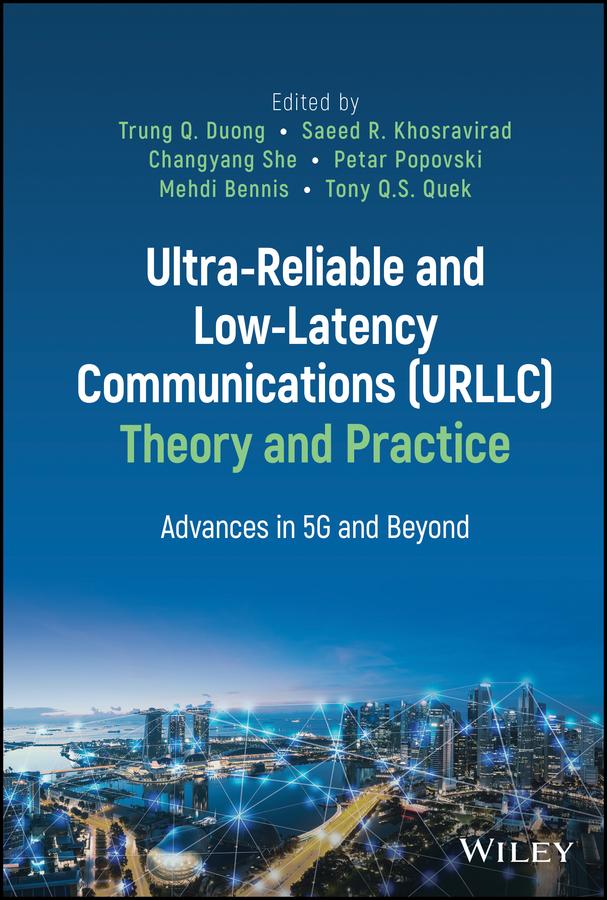
Comprehensive resource presenting important recent advances in wireless communications for URLLC services, including device-to-device communication, multi-connectivity, and more
Ultra-Reliable and Low-Latency Communications (URLLC) Theory and Practice discusses the typical scenarios, possible solutions, and state-of-the-art techniques that enable URLLC in different perspectives from the physical layer to higher-level approaches, aiming to tackle URLLC’s challenges with both theoretical and practical approaches, which bridges the lacuna between theory and practice.
With long-term contributions to the development of future wireless networks, the text systematically presents a thorough study of the novel and innovative paradigm of URLLC; basic requirements are covered, along with essential definitions, state-of-the-art technologies, and promising research directions of URLLC. To aid in reader comprehension, tables, figures, design schematics, and examples are provided to illustrate abstract engineering concepts and make the text more accessible to a broader readership, and corresponding case studies are included in the last part of the book.
Fundamental problems in URLLC, including designing building blocks for URLLC, radio resource management in URLLC, resource optimization, network availability guarantee, and coexisting with other future mobile networks, are also discussed.
In Ultra-Reliable and Low-Latency Communications (URLLC) Theory and Practice, readers can expect to find detailed information on:
- BCH and analog codes, stable matching, OFDM demodulation and turbo coding, and semi-blind receivers for URLLC
- MIMO-NOMA with URLLC, PHY and MAC layer technologies for URLLC, and Network slicing or SDN for URLLC and eMBB
- Integrating theoretical knowledge into deep learning for URLLC, Energy-Latency tradeoff in URLLC, and Downlink transmission for URLLC under physical layer aspects
- Resource allocation for multi-user downlink URLLC, HARQ optimization for 5G URLLC, and Multi-Access edge computing with URLLC
A unique resource with comprehensive yet accessible coverage of a complicated subject, Ultra-Reliable and Low-Latency Communications (URLLC) Theory and Practice is an ideal resource for a large and diverse population of researchers and practitioners in engineering, computer scientists, and senior undergraduate and graduate students in related programs of study.
Pay easily by card, Klarna, Apple Pay or Google Pay. Not happy? You always have a 14-day money-back guarantee. Read more in our terms. If you have any questions, email us at hello@memmo.org.
Memmo makes studying easier – wherever you are in the world. We bring your course books and smart study tools together in one place: summaries, quizzes, podcasts and flashcards. Plus Ted, your study buddy who answers anything you wonder. Over 50,000 students already study here – built to help you learn faster and stress less.