
“In this path-breaking book, Mahito Hayashi explores the rescaled geographies of homelessness that have been produced in contemporary Japanese cities. Through an original synthesis of regulationist political economy and immersive place-based research, Hayashi situates urban homelessness in Japan in comparative-international contexts. The book offers new theoretical perspectives from which to decipher emergent forms of urban marginality and their contestation.”
—Neil Brenner, Lucy Flower Professor of Urban Sociology, University of Chicago
“Mahito Hayashi traces the shifting spatial strategies of unhoused people as they create spaces of emancipation within Japanese cities. Attending to the complexities of contentious class politics and livelihoods barely sustained by the survival economies, Rescaling Urban Poverty is a unique and valuable contribution to the study of the geographies of urban social movements.”
—Nik Theodore, Head of the Department of Urban Planning and Policy, University of Illinois Chicago
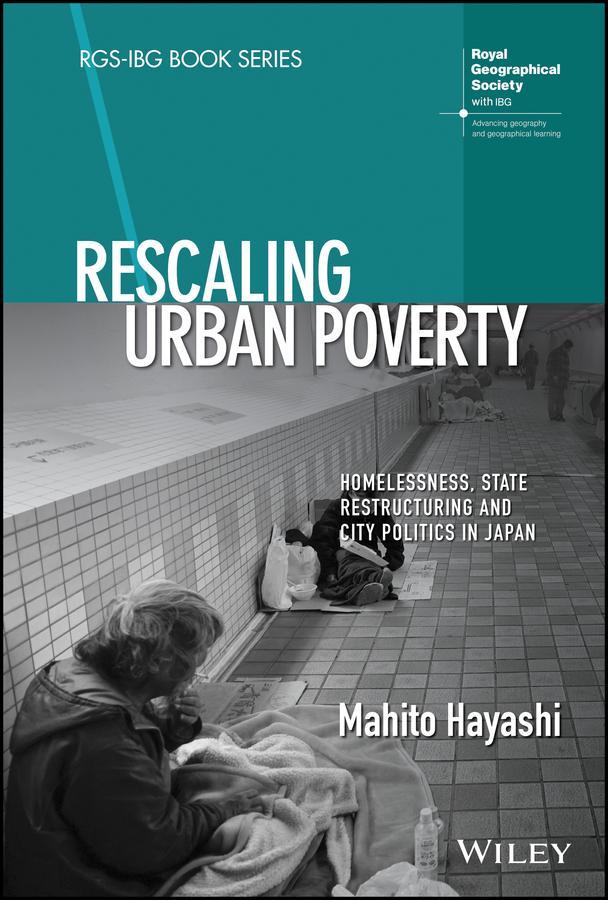
Rescaling Urban Poverty discloses the hidden dynamics of state rescaling that ensnares homeless people at the fringes of mainstream society and its housing regimes/classes.
- Explains the oppressive effects of rescaling and its limits in the interplay of the state, domiciled society, public space, urban class relations, social movements, and capitalism
- Uses ethnography as a re-ontologising medium of critical theorisation in Lefebvrian, Gramscian, Harveyan, and other Marxian strands
- Develops rich context-based and field-based arguments about social movements, poverty and housing policy, and public space formation in Japan
- Uncovers the radical geographies of placemaking, commoning, and translation that can create prohomeless urban environments under rescaling
- Refines the method of abstraction to broaden the international scope of critical literatures and links different scholarly standpoints without obscuring disagreements
By advancing a broad research program for homelessness and poverty, Rescaling Urban Poverty provides the essential understanding of how state rescaling ensnares homeless and impoverished people in the interplay of the state, domiciled society, public space, urban class relations, social movements, and capitalism. Its three angles – national states, public and private spaces, and urban social movements – uncover the hidden dynamics of rescaling that emerge, and are resisted, at the fringes of mainstream society and its housing regimes/classes. Evidence is drawn from Japanese cities where the author has conducted long-term fieldwork and develops robust urban narratives by mobilising spatial regulation theory, metabolism theory, state theory, and critical housing theory. The book cross-fertilises these Lefebvrian, Gramscian, Harveyan, and other Marxian strands through meticulous efforts to reinterpret both old and new texts. By building bridges between classical and contemporary interests, and between the theories and Japanese cities, this book attracts various audiences in geography, sociology, urban studies, and political economy.
Pay easily by card, Klarna, Apple Pay or Google Pay. Not happy? You always have a 14-day money-back guarantee. Read more in our terms. If you have any questions, email us at hello@memmo.org.
Memmo makes studying easier – wherever you are in the world. We bring your course books and smart study tools together in one place: summaries, quizzes, podcasts and flashcards. Plus Ted, your study buddy who answers anything you wonder. Over 50,000 students already study here – built to help you learn faster and stress less.