
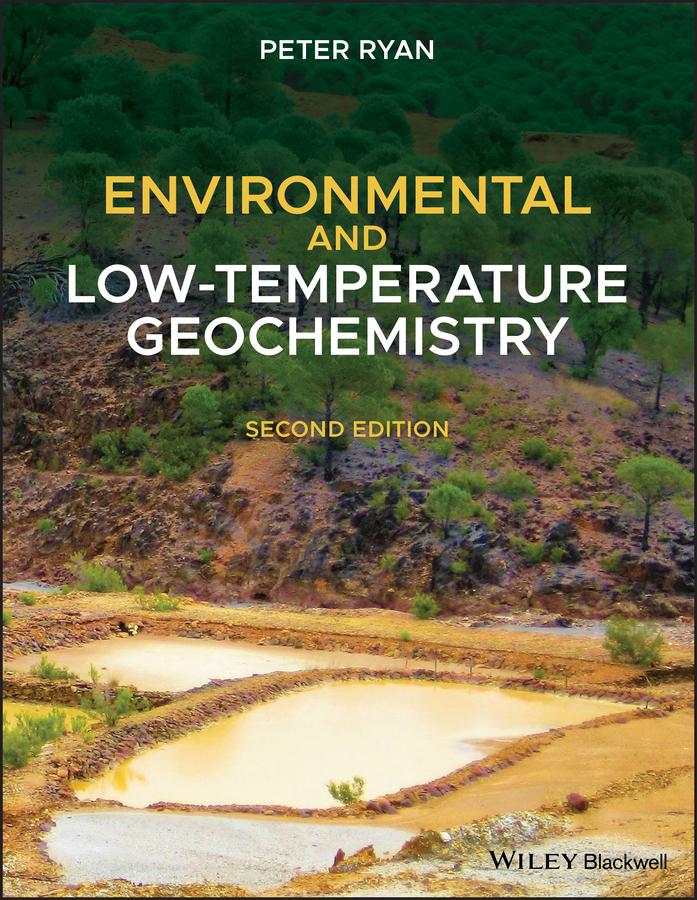
Environmental and Low-Temperature Geochemistry presents conceptual and quantitative principles of geochemistry in order to foster understanding of natural processes at and near the earth’s surface, as well as anthropogenic impacts and remediation strategies. It provides the reader with principles that allow prediction of concentration, speciation, mobility and reactivity of elements and compounds in soils, waters, sediments and air, drawing attention to both thermodynamic and kinetic controls. The scope includes atmosphere, terrestrial waters, marine waters, soils, sediments and rocks in the shallow crust; the temporal scale is present to Precambrian, and the spatial scale is nanometers to local, regional and global.
This second edition of Environmental and Low-Temperature Geochemistry provides the most up-to-date status of the carbon cycle and global warming, including carbon sources, sinks, fluxes and consequences, as well as emerging evidence for (and effects of) ocean acidification. Understanding environmental problems like this requires knowledge based in fundamental principles of equilibrium, kinetics, basic laws of chemistry and physics, empirical evidence, examples from the geological record, and identification of system fluxes and reservoirs that allow us to conceptualize and understand. This edition aims to do that with clear explanations of fundamental principles of geochemistry as well as information and approaches that provide the student or researcher with knowledge to address pressing questions in environmental and geological sciences.
New content in this edition includes:
- Focus Boxes – one every two or three pages – providing case study examples (e.g. methyl isocyanate in Bhopal, origins and health effects of asbestiform minerals), concise explanations of fundamental concepts (e.g. balancing chemical equations, isotopic fractionation, using the Keq to predict reactivity), and useful information (e.g. units of concentration, titrating to determine alkalinity, measuring redox potential of natural waters);
- Sections on emerging contaminants for which knowledge is rapidly increasing (e.g. perfluorinated compounds, pharmaceuticals and other domestic and industrial chemicals);
- Greater attention to interrelationships of inorganic, organic and biotic phases and processes;
- Descriptions, theoretical frameworks and examples of emerging methodologies in geochemistry research, e.g. clumped C-O isotopes to assess seawater temperature over geological time, metal stable isotopes to assess source and transport processes, X-ray absorption spectroscopy to study oxidation state and valence configuration of atoms and molecules;
- Additional end-of-chapter problems, including more quantitatively based questions.
- Two detailed case studies that examine fate and transport of organic contaminants (VOCs, PFCs), with data and interpretations presented separately. These examples consider the chemical and mineralogical composition of rocks, soils and waters in the affected system; microbial influence on the decomposition of organic compounds; the effect of reduction-oxidation on transport of Fe, As and Mn; stable isotopes and synthetic compounds as tracers of flow; geological factors that influence flow; and implications for remediation.
The interdisciplinary approach and range of topics – including environmental contamination of air, water and soil as well as the processes that affect both natural and anthropogenic systems – make it well-suited for environmental geochemistry courses at universities as well as liberal arts colleges.
Pay easily by card, Klarna, Apple Pay or Google Pay. Not happy? You always have a 14-day money-back guarantee. Read more in our terms. If you have any questions, email us at hello@memmo.org.
Memmo makes studying easier – wherever you are in the world. We bring your course books and smart study tools together in one place: summaries, quizzes, podcasts and flashcards. Plus Ted, your study buddy who answers anything you wonder. Over 50,000 students already study here – built to help you learn faster and stress less.