
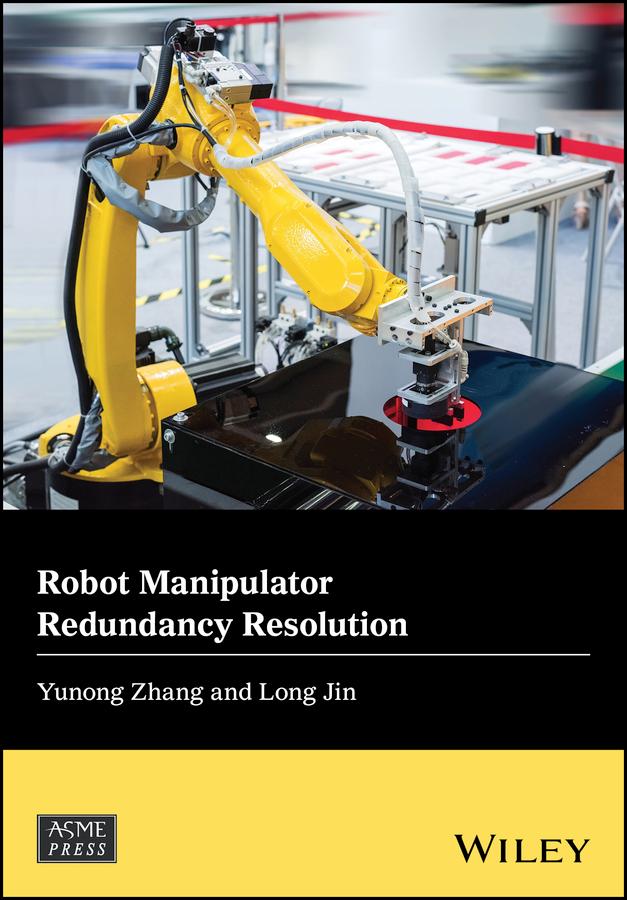
Introduces a revolutionary, quadratic-programming based approach to solving long-standing problems in motion planning and control of redundant manipulators
This book describes a novel quadratic programming approach to solving redundancy resolutions problems with redundant manipulators. Known as ``QP-unified motion planning and control of redundant manipulators'' theory, it systematically solves difficult optimization problems of inequality-constrained motion planning and control of redundant manipulators that have plagued robotics engineers and systems designers for more than a quarter century.
An example of redundancy resolution could involve a robotic limb with six joints, or degrees of freedom (DOFs), with which to position an object. As only five numbers are required to specify the position and orientation of the object, the robot can move with one remaining DOF through practically infinite poses while performing a specified task. In this case redundancy resolution refers to the process of choosing an optimal pose from among that infinite set. A critical issue in robotic systems control, the redundancy resolution problem has been widely studied for decades, and numerous solutions have been proposed. This book investigates various approaches to motion planning and control of redundant robot manipulators and describes the most successful strategy thus far developed for resolving redundancy resolution problems.
- Provides a fully connected, systematic, methodological, consecutive, and easy approach to solving redundancy resolution problems
- Describes a new approach to the time-varying Jacobian matrix pseudoinversion, applied to the redundant-manipulator kinematic control
- Introduces The QP-based unification of robots' redundancy resolution
- Illustrates the effectiveness of the methods presented using a large number of computer simulation results based on PUMA560, PA10, and planar robot manipulators
- Provides technical details for all schemes and solvers presented, for readers to adopt and customize them for specific industrial applications
Robot Manipulator Redundancy Resolution is must-reading for advanced undergraduates and graduate students of robotics, mechatronics, mechanical engineering, tracking control, neural dynamics/neural networks, numerical algorithms, computation and optimization, simulation and modelling, analog, and digital circuits. It is also a valuable working resource for practicing robotics engineers and systems designers and industrial researchers.
Pay easily by card, Klarna, Apple Pay or Google Pay. Not happy? You always have a 14-day money-back guarantee. Read more in our terms. If you have any questions, email us at hello@memmo.org.
Memmo makes studying easier – wherever you are in the world. We bring your course books and smart study tools together in one place: summaries, quizzes, podcasts and flashcards. Plus Ted, your study buddy who answers anything you wonder. Over 50,000 students already study here – built to help you learn faster and stress less.